
The Sudden Appearance of Cracked Caulk This November
The November heating season brings a welcome relief from the outdoor chill, but it also introduces a frustrating surprise for many homeowners. You step into the shower, and suddenly, you notice the sealant pulling away from the tub or peeling at the corners. If you are wondering why bathroom caulk shrinks in winter, the answer lies in the invisible environmental changes happening inside your home.
Most homeowners don't realize that this sudden failure is rarely a sign of a poor initial installation. Instead, it is a direct physical reaction to the shifting climate indoors. Here at Bathtub Reglazing On The Hudson, our team routinely fields calls from Peekskill homeowners each fall who are baffled by their failing sealant. When the furnace kicks on and runs constantly, the atmosphere in your bathroom fundamentally changes. The materials that make up your shower and tub surround are forced to adapt to a new, hyper-dry reality.
The immediate decision point: When you see those first gaps appear, you face a choice. Do you attempt a quick patch over the cracks with a tube from the hardware store, or do you invest in complete removal and replacement? Understanding the environmental physics at play is the key to making a permanent fix. For those seeking long-term durability, exploring professional reglazing services often provides a more integrated, moisture-resistant barrier than standard caulking alone.
Recognizing the Early Signs of Seasonal Failure
Before caulk completely fails, it usually sends warning signals. Catching these signs early can prevent water from seeping behind your walls. Here is what to look for as the weather turns cold:
• Micro-tears along the seam: Tiny, hairline fractures where the caulk meets the tub or tile.
• Loss of elasticity: The sealant feels hard, brittle, or chalky to the touch rather than rubbery.
• Curling edges: The top or bottom edge of the caulk bead begins to lift away from the surface.
• Discoloration: A sudden yellowing or darkening, which can indicate that the material is drying out and degrading.
When these symptoms appear during the November heating season, it is a clear indicator that the indoor climate is stressing your bathroom's defenses.
How Forced-Air Systems Strip Moisture from Your Bathroom
To understand the root cause of seasonal caulk failure, we have to look at how heating systems alter the indoor environment. The abrupt shift into the Northeast winter heating season creates an artificially dry indoor environment that shocks bathroom materials. When forced hot air circulates through your vents, it rapidly consumes ambient moisture.
The ideal indoor humidity level for most building materials sits comfortably between 30% and 50%. However, constant winter heating causes a drastic drop in indoor relative humidity, sometimes pushing levels down to 15% or 20%. This aggressively dry air acts like a sponge, pulling moisture out of everything it touches—including wood, drywall, and standard acrylic sealants.
Here is the thing: your bathroom experiences a violent swing in environments every single day. For twenty-three hours, it sits in hyper-dry, heated air. Then, for one hour, a hot shower floods the room with heavy steam and direct water exposure. This extreme contrast creates immense stress on standard materials.
The Humidity Contrast: Summer vs. Winter
• Average Indoor Humidity — Summer Conditions: 45% - 60% (Moist) — Winter Heating Conditions: 15% - 25% (Hyper-Dry)
• Caulk Elasticity — Summer Conditions: High flexibility and stretch — Winter Heating Conditions: Brittle, stiff, and prone to tearing
• Ambient Air Impact — Summer Conditions: Supports material hydration — Winter Heating Conditions: Actively strips moisture from surfaces
• Substrate Movement — Summer Conditions: Expanded and stable — Winter Heating Conditions: Contracted, widening joint gaps
This drastic drop in indoor relative humidity desiccates standard builder-grade caulks. They lose their internal moisture, which is the very thing that gives them their rubbery, flexible nature. Once that moisture is gone, the caulk physically shrinks, setting the stage for mechanical failure.
The Science of Material Contraction and Caulk Stress
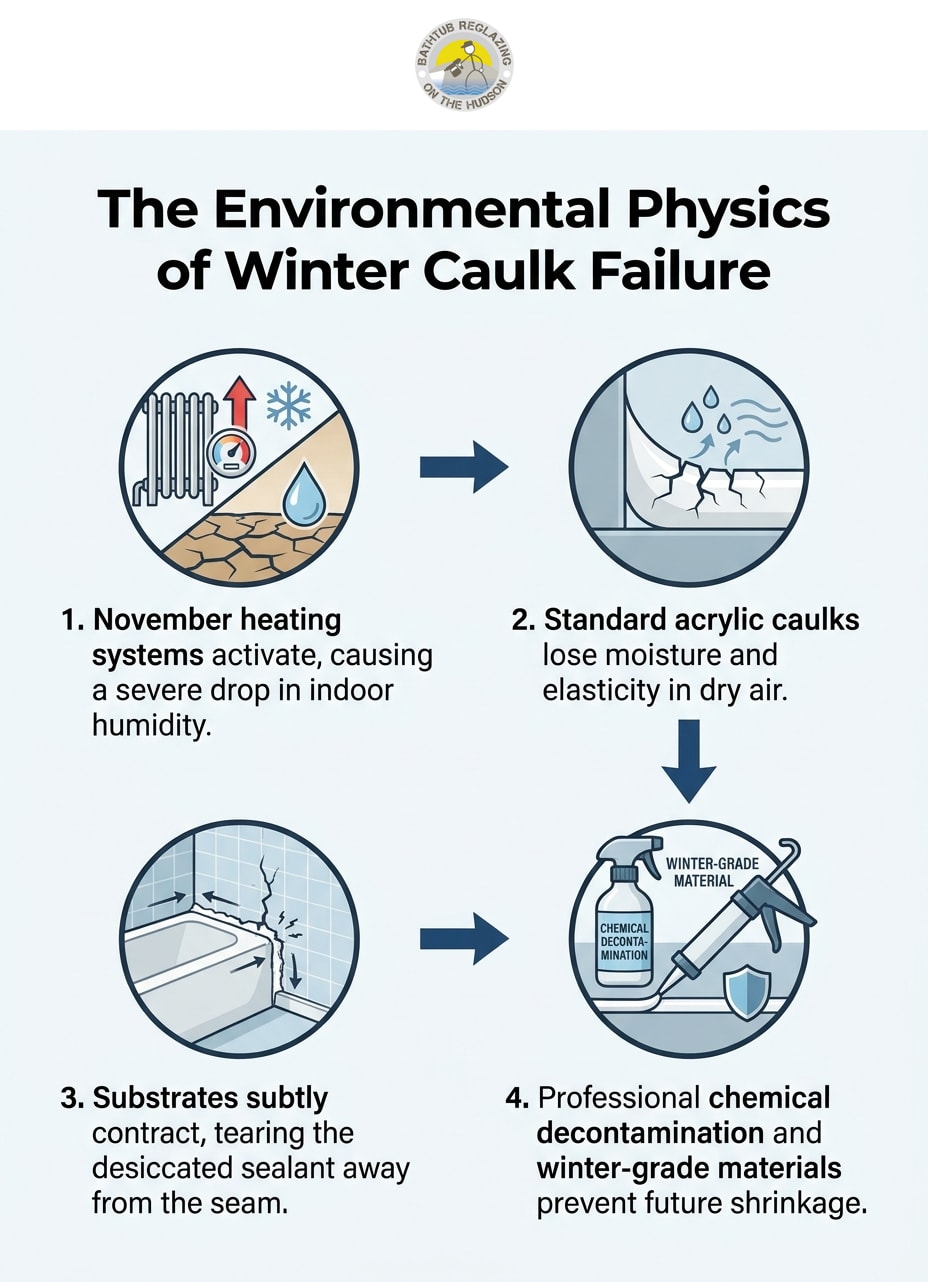
Building science relies heavily on the principles of thermal and moisture-driven contraction. In regions like the Hudson Valley / Peekskill NY area, where extended freezing temperatures demand constant indoor heating, homes undergo subtle but significant structural shifts. As the air dries out, the wood framing behind your walls and beneath your floors loses moisture and slightly contracts.
This means your bathtub and the surrounding walls are actually moving. The movement is microscopic—perhaps just a fraction of a millimeter—but it is enough to widen the gap between the tub deck and the tile. In a humid summer environment, healthy caulk simply stretches to span that widening gap. But in winter, the rules change.
Because the hyper-dry air has already robbed standard acrylic caulks of their elasticity, they can no longer flex. When the tub and wall shift, the dried-out caulk cannot stretch. Instead, the mechanical stress causes it to tear right down the middle or pull cleanly away from the ceramic or fiberglass surface.
The Mechanical Breakdown Process
1. Desiccation: The constant winter heat bakes the flexibility out of the acrylic sealant.
2. Contraction: The underlying building materials shrink as they lose ambient moisture.
3. Tension: The widening joint places immense pulling force on the hardened caulk.
4. Failure: The bond breaks, leaving an open channel for water to enter during the next shower.
One pattern our technicians see constantly in local homes is that this loss of elasticity is permanent for standard acrylic materials once they have been desiccated. No amount of summer humidity will make cracked, hardened caulk flexible again. This is why routine tub cleaning and maintenance should always include a visual inspection of your sealant lines before the coldest months arrive.
The Patching Trap: Why Quick Fixes Fail in Dry Conditions
When cracks appear during the November heating season, the most common homeowner instinct is to grab a fresh tube of sealant and squeeze it directly over the failing joints. It seems like a logical, immediate fix. However, this approach—often called the patching trap—is a deeply flawed strategy that usually fails within a matter of weeks.
The short answer is that new sealant cannot properly adhere to old, shrunken, and desiccated caulk. Caulking relies on a clean, porous, and chemically neutral surface to form a watertight bond. When you apply fresh material over a degraded, dirty, or soap-scum-covered layer, the new caulk only grips the surface dirt and the failing layer beneath it. As the old caulk continues to shrink and peel away from the wall, it takes the new patch right off with it.
Furthermore, the dry winter air severely impacts the curing process of newly applied retail caulk. Standard caulks need a specific balance of humidity to cure into a flexible rubber state. If the air is too dry, the outer layer of the new patch skins over too quickly, trapping uncured material underneath and weakening the overall structure.
Why Temporary Patches Break Down Quickly
• Poor Adhesion: Fresh material cannot bond chemically to hardened, oxidized acrylic or silicone.
• Trapped Contaminants: Patching over cracks seals in existing mildew, soap scum, and body oils.
• Curing Shock: The drastic drop in indoor relative humidity causes the new patch to cure unevenly, leading to immediate brittleness.
• Compound Stress: The new layer adds weight and tension to an already failing baseline joint.
Ultimately, patching only creates a temporary, superficial bridge. It looks good for a few days, but it will inevitably fail again as the season progresses. This cycle of frustration is exactly why comprehensive solutions, like professional bathroom tile reglazing and complete joint replacement, are necessary to achieve a permanent seal.
Hidden Moisture Threats During the Winter Months
Leaving shrunken, compromised caulk unaddressed during the winter season poses a massive risk to your home's infrastructure. It is easy to assume that because the ambient air in the house is dry, moisture damage isn't a pressing concern. This is a dangerous misconception.
Even though the forced-air heating creates a drastic drop in indoor relative humidity outside the shower, the shower itself still introduces heavy, concentrated moisture directly to those compromised seams every single day. When water cascades down the tile, it finds the path of least resistance. A crack in the caulk as thin as a piece of paper is wide enough to draw water behind the wall through capillary action.
Once water seeps behind the shrunken caulk, it enters a dark, enclosed wall cavity. Because the front of the joint is partially sealed, the dry ambient air in the bathroom cannot reach inside the wall to dry that moisture out. The water gets trapped.
The Anatomy of Hidden Water Damage
The unseen progression: Trapped moisture behind the tile board quickly becomes a breeding ground for unseen mold and mildew. In our experience repairing water-damaged surrounds, this daily intrusion of water begins to rot the wood framing and degrade the drywall or backer board over the course of a long winter. By the time you notice soft spots in the wall or a damp smell in the bathroom, the structural damage is already extensive.
This is why pre-winter readiness is critical. Addressing these gaps early prevents larger moisture damage from accumulating. Framing professional intervention as a protective measure for your home's infrastructure is the right mindset. Securing a watertight perimeter through complete replacement or bathtub reglazing ensures that the daily deluge of shower water stays safely inside the drainage system, where it belongs.
The Role of Surface Science in Permanent Caulk Replacement
Solving winter shrinkage requires far more than just buying a more expensive tube of caulk from the hardware store. It requires a fundamental understanding of surface science and complete chemical decontamination of the substrate. This is where professional intervention separates itself from standard DIY efforts.
At Bathtub Reglazing On The Hudson, our hands-on experience in the field and deep technical knowledge of surface science drive our approach. True professionals understand environmental impacts beyond just aesthetics. We know from countless Peekskill bathroom restorations that old silicone and acrylic residues must be completely eradicated at a microscopic level to ensure new materials bond securely. If even a microscopic film of old silicone remains on the porcelain or tile, new sealant will simply slide off or fail to cure properly.
Professional surface science addresses the root cause of adhesion failure. It involves stripping the joint bare, neutralizing the surface pH, and utilizing specialized bonding agents that prepare the substrate to receive new material. This rigorous preparation creates a bond that withstands extreme humidity fluctuations and the constant expansion and contraction of the Hudson Valley / Peekskill NY winter season.
Eradicating Microscopic Residue
When professionals tackle a failing joint, the focus is on decontamination. This process ensures that the new barrier becomes an integrated part of the wall and tub, rather than just a sticky layer sitting on top. If you want to understand the complexity of this preparation, learning about the challenges of removing old silicone caulk reveals why standard scraping and scrubbing is never enough.
This level of scientific preparation is what separates a professional, winter-resistant application from a temporary fix. By addressing the chemistry of the surface, professionals ensure that the new materials can perform exactly as engineered, regardless of how aggressively the furnace runs.
Why Professional Preparation Outlasts Standard Winter Caulking
The lifespan of retail caulks applied over poorly prepared surfaces is notoriously short, especially when subjected to the stress of the November heating season. In contrast, high-flexibility, winter-grade alternatives applied by professionals are engineered specifically to handle environmental extremes.
Professional-grade materials are formulated with advanced polymers that maintain their elasticity even when indoor heating strips moisture from the air. They do not rely on ambient humidity to stay rubbery; their chemical structure is inherently flexible. This means that when your home's framing slightly contracts in January, the professional-grade joint stretches effortlessly to accommodate the movement without tearing.
Retail Caulking vs. Professional Surface Preparation
• Surface Cleaning — Standard Retail Application: Basic scraping and wiping — Professional Preparation & Replacement: Chemical decontamination and microscopic residue removal
• Material Flexibility — Standard Retail Application: Relies on ambient moisture — Professional Preparation & Replacement: Engineered polymer elasticity
• Reaction to Dry Heat — Standard Retail Application: Shrinks, hardens, and cracks — Professional Preparation & Replacement: Maintains structural integrity and stretch
• Lifespan — Standard Retail Application: Often fails within one season — Professional Preparation & Replacement: Provides years of watertight protection
Hiring an expert ensures the job is done right the first time, avoiding repeated seasonal failures and the constant frustration of chasing leaks. Choosing professional replacement over temporary DIY patches gives you peace of mind, knowing your bathroom is secured by materials and methods designed for the harsh realities of winter heating.
Frequently Asked Questions About Seasonal Caulk Failure
Why does caulk pull away from the tub in winter?
Caulk pulls away from the tub in winter because of a drastic drop in indoor relative humidity caused by constant furnace heating. This dry air pulls moisture out of standard acrylic sealants, causing them to shrink and lose their elasticity. At the same time, the dry air causes the wood framing in your home to subtly contract, widening the joint and physically tearing the hardened caulk away from the tub surface.
Can dry heat cause bathroom caulk to crack?
Yes, dry heat is one of the primary causes of bathroom caulk cracking. When forced-air systems run constantly, they create an artificially dry environment that bakes the flexibility right out of builder-grade materials. Without that internal moisture, the caulk becomes brittle and snaps under the normal micro-movements of the house.
Should I patch cracked caulk or replace it entirely?
You should always replace cracked caulk entirely rather than attempting to patch it. New sealant cannot chemically bond to old, desiccated, or dirty caulk, meaning a patch will quickly peel away. Complete removal and microscopic decontamination of the surface are required to ensure the new application forms a permanent, watertight seal.
Does temperature affect how bathroom caulking cures and ages?
Temperature and humidity profoundly affect both the curing process and the aging of bathroom caulking. If applied in an environment that is too dry or too cold, standard caulks will skin over too quickly and fail to cure properly underneath. Over time, extreme temperature fluctuations accelerate the aging process, causing inferior materials to harden and degrade much faster than they would in stable climates.
How does indoor humidity impact the lifespan of bathroom sealants?
Indoor humidity acts as a stabilizing force for the elasticity of many standard sealants. When humidity remains balanced (between 30% and 50%), the sealant stays hydrated and flexible. However, when winter heating causes a drastic drop in indoor relative humidity, the sealant dries out prematurely, drastically shortening its lifespan and leading to rapid mechanical failure.
Protect Your Bathroom's Integrity This Winter Season
Ultimately, shrinking caulk is a scientific reaction to winter heating, not a random failure or a stroke of bad luck. The combination of the November heating season in the Hudson Valley / Peekskill NY area and the resulting drop in indoor moisture creates an environment that standard materials simply cannot survive.
However, you do not have to accept seasonal cracking as a permanent reality. With the right professional intervention, complete chemical decontamination, and high-grade materials, the problem can be permanently resolved. The key is acting before the tiny cracks allow water to rot the hidden structures behind your tile.
As the cold weather sets in permanently, now is the time to safeguard your bathroom. We encourage you to explore professional options to address failing joints properly, ensuring your home remains beautiful, watertight, and structurally sound all winter long.
Schedule Service
Thank you! Your submission has been received!
Oops! Something went wrong while submitting the form.
Other Blogs
Customer Testimonials
Hear what customers are saying about our professional refinishing and outstanding results.

Can’t say enough about Maurice. From start to finish great communication his work is incredible and he stands by it very competitive pricing just all-around good guy the work was done quick and kept very clean and our brand new bathroom
Joey N.
We had a large piece of bathtub glaze chip off. Maurice came in and did a fantastic job. It now looks and works better than before. He went above and beyond the contract by cleaning up the old chipped grout between the tub and the tiles and replacing with brand new.
Bozidar J.
Maurice did a great job on my tub. It looks brand new.
Steven S.