


The Myth of Mandatory Demolition for Outdated Bathroom Vanities
When considering reglazing a cultured marble vanity vs. installing a new quartz top, many homeowners believe the only way to eliminate a faded or yellowing bathroom sink is to rip out the entire fixture—but that is a costly misconception. For decades, the standard approach to bathroom remodeling has been a complete tear-out, operating on the assumption that anything aesthetically dated must be structurally compromised. This is rarely the case. Updating a structurally sound vanity does not have to trigger a messy, disruptive demolition project that leaves your bathroom unusable for weeks.
If you are looking for professional reglazing services, our team at Bathtub Reglazing On The Hudson always emphasizes the importance of understanding your options before swinging a sledgehammer. The decision ultimately comes down to weighing the appeal of brand-new quartz against the plumbing complexities and tear-out mess required to install it. For many properties, particularly those featuring a classic 80s/90s integrated cultured marble vanity, the underlying structure is incredibly solid. The surface may be scratched, dulled by decades of abrasive cleaners, or suffering from severe UV yellowing, but the unit itself is completely functional.
Reglazing offers an alternative path that balances a modern aesthetic with logistical efficiency. Instead of treating your existing vanity as construction debris, modern restoration techniques treat it as a blank canvas. By bypassing the demolition phase entirely, homeowners can achieve a factory-new finish without the cascading complications that inevitably arise when you start tearing fixtures off the walls of an older home. The key is understanding exactly what you are getting into with both options before making a final decision.
Understanding the Logistical Nightmare of Removing Integrated Sinks
Cultured marble vanities from previous decades typically feature a single, continuous piece that includes the sink bowl, the countertop, and often a seamlessly integrated backsplash. While this one-piece design was highly prized for its water resistance, it presents a massive hurdle for modern renovations. These single-piece units are exceptionally heavy, awkward to maneuver in tight bathroom spaces, and almost always glued securely to the underlying vanity cabinet with industrial-strength construction adhesives.
Attempting to pry off an integrated top frequently results in structural damage to the cabinet base, turning a simple top replacement into a full vanity replacement. The hidden costs of cabinet repair, leveling, and reinforcement are rarely factored into initial renovation plans, catching homeowners off guard when a contractor reveals that the existing base cannot be salvaged. If you are exploring sink and vanity reglazing, avoiding this specific logistical nightmare is often a primary motivation we hear from our clients.
The Risk to Existing Cabinetry
The adhesives used in older installations harden and crystallize over time, bonding the marble top permanently to the wood or medium-density fiberboard (MDF) below. When removal begins, the process is rarely clean.
• Splintering frames: Forced removal often splinters the cabinet frame, tearing away the top layer of the wood where the glue was applied.
• Compromised corners: The lateral force required to break the adhesive bond can loosen the corner braces of the cabinet, causing the entire structure to wobble.
• Wall damage: Because the integrated backsplash is usually caulked and glued to the drywall, tearing it out often rips away the drywall paper, requiring patching, mudding, and repainting before a new top can even be considered.
Once the cabinet frame is compromised, its ability to hold a new, heavier top is completely negated. What started as a surface-level aesthetic update suddenly snowballs into a major carpentry and drywall repair project.
Structural and Plumbing Realities of Heavy Quartz Upgrades
Quartz is a beautiful, highly durable material, but it is also one of the heaviest countertop materials available on the market. It frequently exceeds the weight capacity of older, standard vanity cabinets that were originally designed to hold lighter acrylic or cultured marble tops. Installing quartz often requires structural cabinet reinforcement prior to installation to meet National Kitchen and Bath Association (NKBA) guidelines for weight distribution and safety.
In our years of servicing Peekskill and the greater Hudson Valley, our team consistently sees older homes where bathroom cabinets were built in place or constructed from materials that have settled over decades. Placing a massive slab of engineered stone on top of an aging, unreinforced cabinet is a recipe for sagging doors, cracked joints, and eventual structural failure. Before a quartz top can be installed, a carpenter must often add interior blocking, reinforce the side panels, and ensure the entire unit is perfectly level to prevent the rigid stone from cracking under its own weight.
Retrofitting Older Plumbing Configurations
The structural weight is only half the battle; the plumbing realities are often far more complex. Transitioning from an integrated sink to an undermount quartz setup changes the drain height, the trap configuration, and the overall geometry of the plumbing beneath the sink.
• Drain height discrepancies: Undermount sinks attached to quartz tops often sit much deeper than shallow 80s/90s integrated bowls. This drops the tailpiece of the drain significantly lower.
• P-trap realignment: Because the drain is lower, the existing P-trap often no longer aligns with the waste pipe exiting the wall.
• Rigid pipe challenges: Older homes often feature rigid copper or early PVC plumbing configurations that do not easily adapt to modern undermount sink depths without extensive modifications.
These plumbing realignments require cutting into the back of the cabinet, opening up the walls, and re-piping the waste line to accommodate the new geometry. This adds significant time, requires a licensed plumber, and drastically increases the complexity of the project.
How Reglazing Transforms Cultured Marble Without the Tear-Out
Reglazing utilizes the existing, structurally sound marble and integrated sink, completely eliminating the need for removal, structural reinforcement, or plumbing retrofits. The process is a highly technical surface restoration that bonds a new, ultra-durable finish directly over the old material. If you have ever looked into bathroom tile reglazing, you'll find our vanity restoration process follows a similarly rigorous methodology to ensure a permanent bond.
The transformation begins with meticulous cleaning and chemical etching to remove decades of soap scum, hard water deposits, and the original factory gloss. Any minor chips, cracks, or deep scratches in the 80s/90s integrated cultured marble vanity are filled and sanded completely smooth. Next, proprietary bonding agents are applied to ensure the new surface adheres at a molecular level. Finally, multiple layers of advanced, high-tech acrylic polyurethane coatings are sprayed on to create a hard, durable shell that looks and feels exactly like a brand-new fixture.
Because the finish is continuous across the counter, the backsplash, and the bowl, it eliminates seams where moisture can penetrate. This seamless barrier is highly resistant to the expansion and contraction caused by seasonal temperature swings. With summer temperatures regularly driving up indoor humidity and cold winters causing structural materials to contract, a seamless, moisture-sealed reglazed finish withstands thermal expansion in the local climate far better than poorly sealed replacement joints or caulked undermount sink seams.
Comparing Aesthetic Outcomes and Surface Durability
When evaluating the final look and feel of your bathroom, both options provide a massive visual upgrade over a yellowed, dated sink, but they achieve that aesthetic in very different ways. Quartz offers a premium, stone-like appearance with natural-looking veining and a highly customized edge profile. However, it comes with visible seams around the undermount sink. No matter how perfectly an undermount sink is installed, there is always a caulked joint where the porcelain meets the stone. Over time, this seam can trap moisture, collect dirt, and require periodic scraping and recaulking to prevent mold growth.
Reglazing provides a smooth, monolithic, high-gloss or matte finish that unifies the space. Modern reglazing compounds cure to an incredibly hard finish that resists daily wear, staining, and UV discoloration. Professional surface preparation guarantees sharp edges and a mirror-smooth sheen that rivals factory finishes, making it virtually impossible to tell that the fixture wasn't just purchased off the showroom floor.
The durability of professional restoration is a proven reality. Just this past summer, our team at Bathtub Reglazing On The Hudson worked with a local homeowner regarding a worn, discolored bathtub fixture needing complete restoration. One of our technicians arrived on time, explained our meticulous restoration process, protected the surrounding area with drop cloths, and kept the space spotless throughout the day. The outcome was a fixture that looked brand new with a flawless, glossy finish. That exact same level of professional service, attention to detail, and mirror-smooth durability applies directly to our vanity top reglazing. The advanced coatings used today are engineered to withstand the daily rigors of bathroom environments without chipping, peeling, or fading.
Project Timelines and Environmental Impact Before the Holidays
Timing is often the deciding factor in any home improvement project, especially during early fall when we see a surge in calls for pre-holiday hosting prep. When you are expecting guests for Thanksgiving or winter holidays, having a bathroom out of commission is simply not an option. Coordinating demolition, structural reinforcement, plumbing retrofits, and quartz templating can leave a bathroom unusable for weeks. You are entirely dependent on the schedules of multiple different tradesmen aligning perfectly.
By contrast, reglazing offers a significantly faster turnaround time. The entire process is typically completed by our crew in a single day, with the surface fully cured and ready for light use within 24 to 48 hours. There is no waiting for a stone fabricator to cut a slab, no waiting for a plumber to rough-in new pipes, and no waiting for drywall mud to dry. You get a completely modernized bathroom over the course of a single weekend, with zero demolition dust tracked through your home.
Beyond the timeline advantages, there is a massive environmental benefit to choosing restoration. Construction and demolition debris accounts for a massive portion of landfill waste according to EPA data. Throwing away hundreds of pounds of perfectly functional cultured marble simply because the color is out of style is highly inefficient. Keeping a perfectly good vanity out of the landfill by opting for a reduced-waste reglazing process is a highly eco-friendly choice for modern homeowners who want to minimize their environmental footprint while maximizing their home's aesthetic appeal.
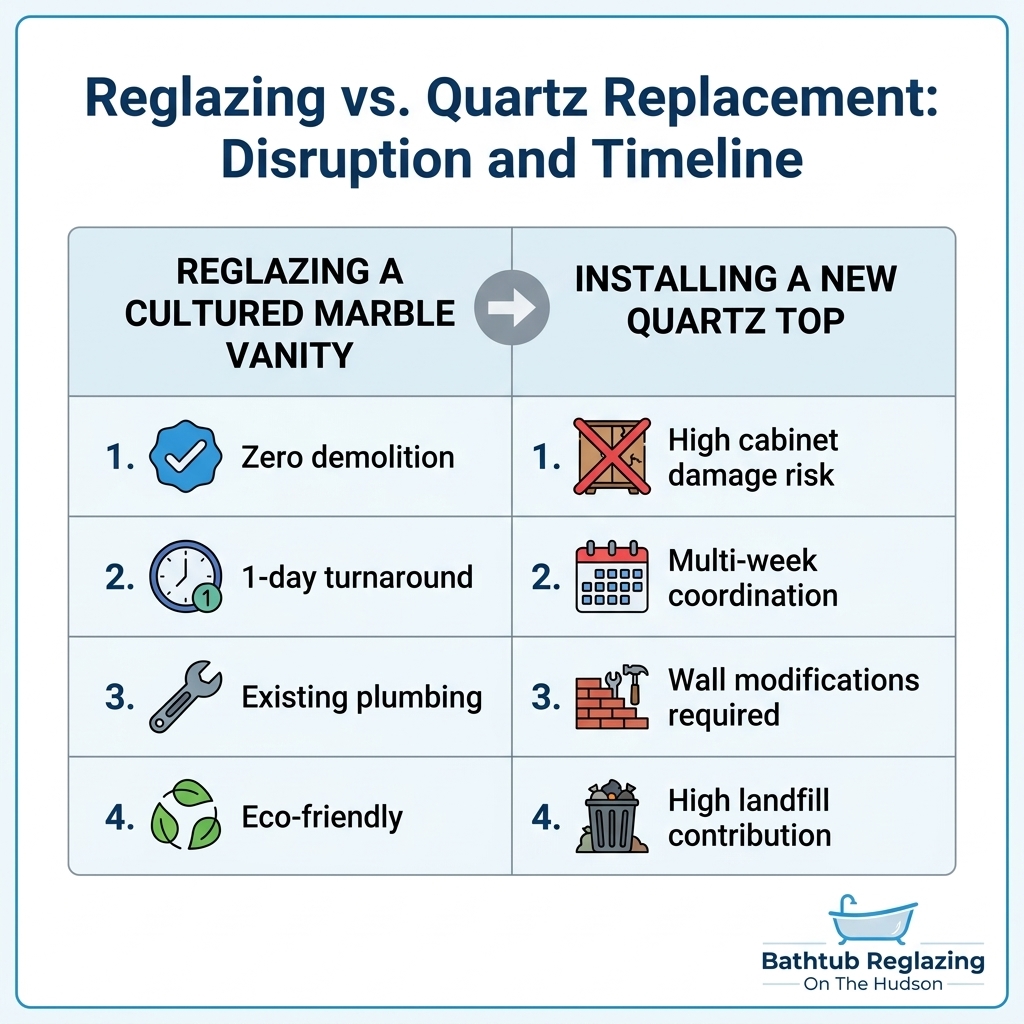
Side-by-Side Comparison: Which Vanity Update is Right for You?
To help clarify the decision-making process for your early fall and pre-holiday hosting prep, it helps to view the logistical requirements of both options side-by-side. While both paths lead to a beautiful bathroom, the journey to get there is vastly different. If you are also considering updating your tub, understanding the broader context of bathtub reglazing vs. replacement follows many of these exact same logistical principles we apply to vanities.
• Installation Disruption — Cultured Marble Reglazing: Done in-place with zero demolition or dust. — New Quartz Installation: Requires heavy demolition, wall repairs, and dust control.
• Project Timeline — Cultured Marble Reglazing: Takes 24 to 48 hours from start to fully cured. — New Quartz Installation: Takes weeks to coordinate templating, fabrication, and multiple trades.
• Cabinet Risk — Cultured Marble Reglazing: Preserves existing cabinet integrity completely. — New Quartz Installation: Risks splintering old wood; requires structural reinforcement.
• Plumbing Requirements — Cultured Marble Reglazing: Uses existing drain height and P-trap alignment. — New Quartz Installation: Often requires wall cuts and pipe retrofitting for deep sinks.
• Environmental Impact — Cultured Marble Reglazing: A green, sustainable alternative that reduces waste. — New Quartz Installation: Contributes heavily to construction landfill waste.
The quick takeaway: If your primary goal is achieving a modern, clean, and highly durable aesthetic without the cascading headaches of plumbing changes and cabinet repairs, reglazing is the most efficient path forward.
Frequently Asked Questions About Vanity Updates
Does replacing a vanity top damage the cabinet?
Yes, replacing an older integrated vanity top carries a high risk of cabinet damage. Because these heavy tops were often secured with strong construction adhesives, prying them off can splinter the wood frame or loosen the corner joints of the cabinet base. If the cabinet is made of older MDF or particleboard, the structural integrity is often permanently compromised during removal.
How long does vanity reglazing take?
The entire vanity reglazing process is typically completed by our technicians within a single day. We clean, prep, and apply the new coatings in just a few hours. After application, the surface usually requires 24 to 48 hours to fully cure before it can be exposed to water or heavy daily use.
Can you change the color of a cultured marble vanity?
Absolutely. Reglazing completely changes the color of a cultured marble vanity, allowing you to cover up dated swirls, fading, or yellowing. Modern coatings are available in brilliant, solid whites and custom shades that mimic the look of high-end porcelain or solid surface materials, completely modernizing the fixture.
Is it necessary to upgrade plumbing when switching to quartz?
In most older homes, switching to a quartz top with an undermount sink will require plumbing modifications. Because undermount sinks sit deeper than shallow integrated marble bowls, the drain tailpiece drops lower, meaning the existing P-trap will no longer align with the waste pipe in the wall. This requires cutting and retrofitting the pipes to accommodate the new geometry.
How does reglazing handle an integrated sink bowl?
Reglazing treats the countertop and the integrated sink bowl as one continuous surface. The technician preps and coats the entire unit—from the backsplash down into the drain flange—creating a seamless, monolithic finish. This eliminates the need for caulked joints and ensures a highly water-resistant barrier across the entire fixture.
Make Your Bathroom Renovation Decision with Confidence
Updating your bathroom shouldn't require unnecessary stress, hidden plumbing costs, or timeline anxiety—especially when you are trying to prepare your home for the upcoming holiday season. The assumption that everything old must be torn out and thrown away often leads homeowners down a path of expensive, disruptive renovations that could have been entirely avoided.
By understanding the structural realities of your current integrated sink, you can choose the path that offers the best value and the least disruption to your daily life. When our team provides a professional assessment, we can quickly determine if your existing vanity is a perfect candidate for a seamless, highly durable update. A clear, objective comparison of the installation disruption and aesthetic outcomes proves that you don't need a sledgehammer to achieve a beautiful, modern bathroom.
Schedule Service
Thank you! Your submission has been received!
Oops! Something went wrong while submitting the form.
Other Blogs
Customer Testimonials
Hear what customers are saying about our professional refinishing and outstanding results.

Can’t say enough about Maurice. From start to finish great communication his work is incredible and he stands by it very competitive pricing just all-around good guy the work was done quick and kept very clean and our brand new bathroom
Joey N.
We had a large piece of bathtub glaze chip off. Maurice came in and did a fantastic job. It now looks and works better than before. He went above and beyond the contract by cleaning up the old chipped grout between the tub and the tiles and replacing with brand new.
Bozidar J.
Maurice did a great job on my tub. It looks brand new.
Steven S.