

The Hidden Complexities of Multi-Unit Bathroom Upgrades
Navigating Westchester County building codes during multi-unit facility bathroom renovations is often the most stressful part of managing property upgrades. Property managers and facility directors face a unique set of hurdles when updating multiple units simultaneously. The concrete problem lies in managing strict local compliance, noise ordinances, and VOC/ventilation cleanup protocols during multi-unit commercial bathroom renovations in Westchester County without disrupting tenants. When multiple units share plumbing stacks, ventilation shafts, and common walls, a simple cosmetic update can quickly trigger complex regulatory oversight.
To streamline your next block of upgrades, partnering with professional reglazing services ensures compliance, and scheduling bathtub reglazing in Westchester County is a smart alternative to full demolition.
The primary decision point for facility managers is how to properly sequence multi-unit bathroom upgrades and schedule commercial cleanup protocols to comply with local noise and safety ordinances. Unlike single-family residential projects, commercial and multi-family properties face significantly stricter oversight. This is because multi-unit buildings present higher risks for fire spread, indoor air quality degradation, and widespread plumbing failures. A mistake in one unit can easily impact dozens of other residents.
Commercial vs. Residential Renovation Hurdles
• Code Oversight — Single-Family Residential: Basic municipal building codes; fewer inspections for cosmetic work. — Multi-Unit Commercial: Stringent state and local fire, safety, and ventilation codes.
• Noise Restrictions — Single-Family Residential: Standard daytime hours; isolated impact on neighbors. — Multi-Unit Commercial: Strict enforcement to prevent disruption to adjacent, paying tenants.
• Ventilation — Single-Family Residential: Standard open-window or basic exhaust fan requirements. — Multi-Unit Commercial: Mandatory mechanical exhaust rates and negative pressure isolation.
• Logistics — Single-Family Residential: Flexible scheduling based on homeowner preference. — Multi-Unit Commercial: Rigid sequencing required to minimize utility shut-offs for the whole building.
Because full tear-outs require extensive plumbing permits, heavy demolition, and prolonged utility shut-offs, many property managers seek less invasive methods. Professional reglazing services offer a fully compliant, highly efficient alternative. By resurfacing existing fixtures in place, you bypass the heavy construction phase, drastically reducing the regulatory burden while still delivering a modernized, clean bathroom for incoming tenants.
Navigating County vs. Municipal Building Regulations
Understanding the layered regulatory environment in New York is essential for keeping your project on track. Commercial properties must adhere to the baseline requirements set forth by the New York State Uniform Fire Prevention and Building Code. This state-level framework dictates structural integrity, fire safety, and baseline mechanical ventilation standards for all multi-family buildings. However, compliance does not stop at the state level.
Westchester County operates under a unique structure where property managers must navigate both state codes and highly localized municipal ordinances. A project in Peekskill may face different permit timelines and zoning restrictions than an identical project in White Plains. Local municipalities enforce their own specific rules regarding contractor licensing, waste disposal, and multi-family zoning permits. For Westchester County multi-unit commercial facilities, this means you must verify compliance at both the county and town levels before any work begins.
Opting for bathtub refinishing in Westchester often bypasses the heavy plumbing permits required for full replacements. Because refinishing does not alter the building's structural footprint or require disconnecting main plumbing lines, it is generally classified as a cosmetic upgrade rather than a structural alteration. This distinction is a massive advantage for facility managers looking to expedite unit turnovers without getting bogged down in municipal permit backlogs.
Understanding Permit Thresholds
Knowing exactly when a permit is triggered can save weeks of project delays. It is critical to differentiate between cosmetic upgrades and structural or plumbing alterations.
• Cosmetic Upgrades: Painting, reglazing, resurfacing, and swapping basic hardware typically do not require extensive permits, as they do not alter the building's infrastructure.
• Structural Alterations: Moving walls, relocating plumbing fixtures, or upgrading electrical panels will always trigger a mandatory permit and subsequent municipal inspections.
• Local Verification: Always verify your specific municipal town codes before beginning work, as some local jurisdictions have strict definitions of what constitutes a structural change.
Managing Construction Noise Ordinances in Occupied Buildings
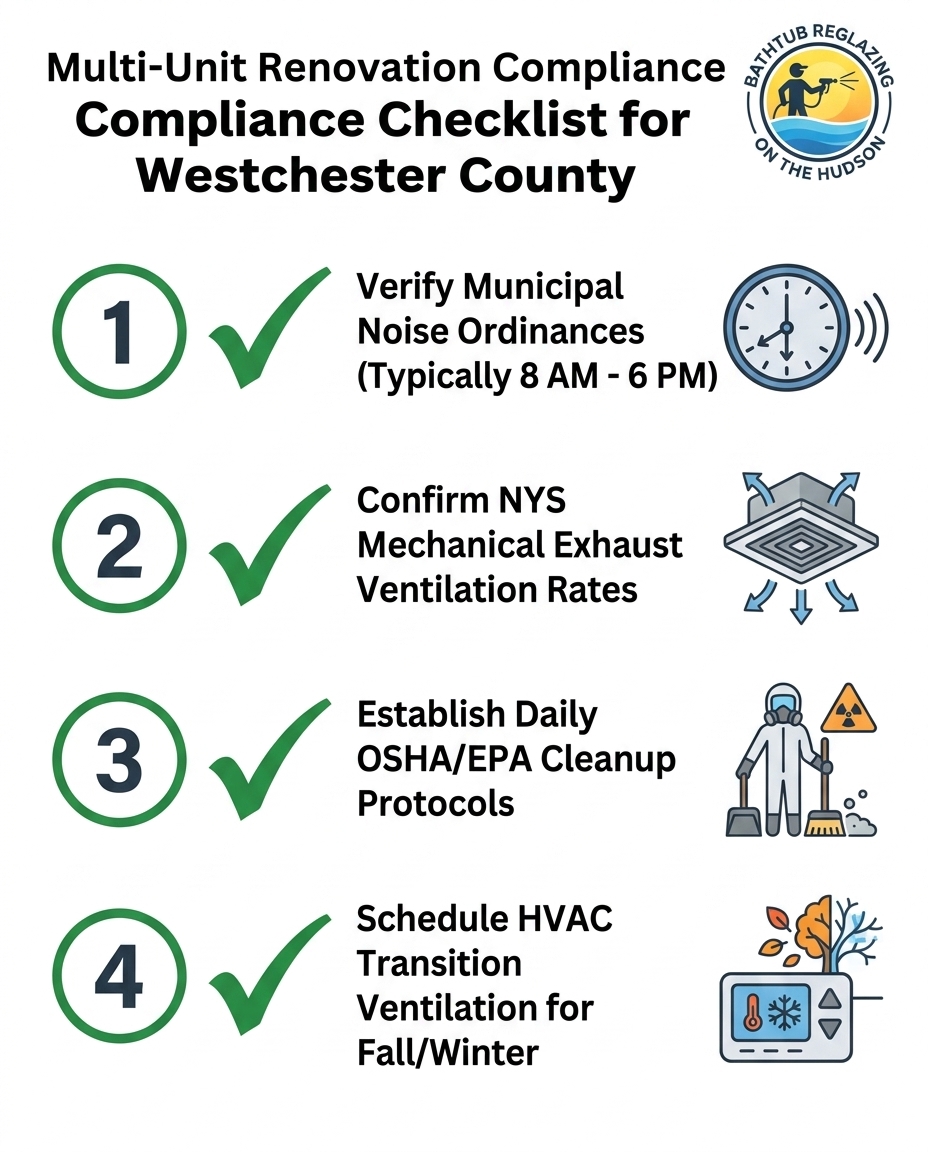
When renovating units in a fully occupied commercial building, noise management is just as critical as plumbing or electrical compliance. Westchester municipalities enforce strict construction noise ordinances, typically restricting heavy work to 8 AM to 6 PM on weekdays. Some towns have even narrower windows or outright ban weekend construction in multi-family zones. Violating these ordinances can result in immediate stop-work orders and steep municipal fines.
However, savvy property managers reframe noise compliance from a legal hurdle to an essential tenant-retention and project-management strategy. Tenants are highly sensitive to prolonged disruption. If a bathroom renovation echoes through the shared walls for weeks, tenant satisfaction plummets, leading to complaints and potential lease non-renewals. Managing this noise proactively shows residents that management respects their living environment.
A typical pattern we see involves proactive communication and rapid execution. One local property manager scheduled a project last summer regarding a unit's bathtub that had suffered severe discoloration after 25 years of sunlight exposure. Because the building was fully occupied, prolonged construction noise from a full tear-out was not an option. The reglazing job was completed in a single day, keeping the disturbance minimal and leaving the main bathroom tub with an amazing, courteous finish. This approach eliminates the grinding, hammering, and hauling associated with traditional demolition.
To maintain goodwill during any upgrade block, communicate renovation schedules effectively to residents in adjacent units. Provide clear notices at least 48 hours in advance, detailing the exact hours work will occur and when the loudest phases are expected. Prompt, professional execution minimizes the duration of disruptive noise, ensuring the project stays compliant and tenants stay happy.
HVAC Transitions and VOC Ventilation Protocols
Proper airflow management is a non-negotiable safety standard during commercial renovations. OSHA and EPA guidelines mandate specific Volatile Organic Compound (VOC) management and ventilation protocols for renovations in occupied commercial buildings. When applying industrial coatings, paints, or reglazing compounds, fumes must be safely extracted from the workspace to protect both the technicians and the building's residents.
The New York State Fire Prevention and Building Code dictates strict mechanical exhaust ventilation rates for multi-unit bathrooms. You cannot simply open a window and hope for the best. Contractors must use high-powered, localized exhaust systems that pull air out of the work area and vent it safely outside, creating a negative pressure environment. This ensures that fumes do not seep under doors or travel through shared HVAC ducts into neighboring apartments.
These protocols become especially complex during seasonal shifts. The September/early fall transition is a critical period for managing ventilation and VOCs as buildings transition to the heating season. During the summer, buildings rely on air conditioning, which often recirculates indoor air. As temperatures drop in early fall, multi-unit buildings shift from cooling to heating. This transition directly impacts indoor air flow, alters the building's natural draft, and changes how VOCs disperse through the property. Furthermore, temperature and humidity fluctuations during this seasonal shift can directly impact the curing times of industrial coatings.
To safely manage this, professional teams implement strict isolation strategies. They seal off supply and return vents in the specific bathroom being worked on, deploy heavy-duty exhaust fans directed out the nearest window, and monitor the ambient temperature to ensure the space remains optimal for proper curing. This meticulous approach guarantees that adjacent tenants never smell the renovation happening next door.
Strict Cleanup Protocols for Commercial Facilities
In a multi-family commercial facility, the condition of the common areas during a renovation is just as important as the final result inside the unit. Emphasizing post-renovation cleanup is a critical compliance standard and a major operational differentiator. Strict commercial facility cleanup protocols and noise ordinance compliance serve as core operational standards for smooth multi-unit projects. If contractors leave debris in the hallways, track dust through the lobby, or leave hazardous materials unsecured, the property manager absorbs the immediate backlash from residents.
Rigorous daily cleanup protocols are required to operate smoothly in occupied spaces. This means treating the building with respect from the moment the crew arrives until they clock out. Leaving a clean site daily protects the property manager's reputation and prevents tenant complaints from escalating to municipal code enforcement.
During an autumn unit turnover, a property manager discovered a large chip in a bathtub's glaze that threatened to delay a new tenant's move-in. The repair team fixed the chip, meticulously cleaned the surrounding grout, and replaced it with new material. By laying down canvas drop cloths, protecting surrounding surfaces, and managing waste properly, the bathtub was restored to look and work better than before without leaving any mess behind. This level of care is essential for maintaining a premium building environment.
When executing bathroom tile reglazing, the process of protecting surrounding surfaces is extensive. Professionals mask off mirrors, vanities, and floors with heavy-duty paper and plastic. They manage hazardous waste, such as used solvents or masking materials, by bagging them securely and removing them from the property daily. This direct connection between cleanliness, overall project safety, and code compliance ensures the property remains safe, hazard-free, and fully operational for the people living there.
Logistical Sequencing for Minimal Disruption
When you are upgrading 10, 20, or 50 bathrooms in a single building, random scheduling leads to chaos. Providing a strategic approach to scheduling blocks of bathroom renovations is the key to minimizing tenant disruption and keeping the project on budget. Logistical sequencing requires careful planning to ensure that trades do not overlap and residents are not left without facilities.
Steps for Sequencing Multi-Unit Upgrades:
1. Audit and Group by Floor Plan: Assess all units slated for upgrades. Group them by identical floor plans to standardize the materials needed and streamline the workflow for the technicians.
2. Schedule in Vertical Stacks: Complete projects in vertical stacks rather than horizontally across a single floor. Because multi-story buildings share plumbing lines vertically, working on a single stack allows you to manage plumbing and ventilation shut-offs efficiently without affecting the entire building.
3. Coordinate Trades Carefully: Ensure that plumbing repairs, drywall patching, and surface refinishing happen in the correct order. Coordinating bathroom refinishing in Westchester County, NY alongside other trades prevents scheduling bottlenecks. Refinishing should always be the final step before the final clean, ensuring the new surface isn't damaged by other workers.
4. Establish a Baseline Timeline: Provide tenants with a firm timeline. A standard bathtub and tile reglazing project in a single unit typically takes one full day to prep and apply, followed by a 24-hour curing period. By sequencing units back-to-back, a professional team can turn over multiple bathrooms in a single week with minimal downtime.
By treating the scheduling process as a precise logistical operation, facility managers can upgrade entire wings of a building while maintaining a peaceful, compliant environment for the residents.
Frequently Asked Questions About Commercial Bathroom Codes
Do I need a permit to renovate a commercial bathroom in Westchester County?
In most cases, structural changes require a permit, while cosmetic updates do not. If your renovation involves moving plumbing lines, altering electrical systems, or tearing down walls, you will need a permit from your local municipality. However, cosmetic upgrades like painting, replacing fixtures, or professional bathtub reglazing typically bypass these heavy permit requirements. Always check with your specific town's building department to confirm their local thresholds.
What are the construction noise hours in Westchester NY?
Most municipalities in Westchester County restrict construction noise to weekdays between 8 AM and 6 PM. Some towns prohibit heavy construction noise entirely on weekends and major holidays, especially in multi-family residential zones. It is vital to verify the exact noise ordinance with your local town or city clerk, as violating these hours can result in stop-work orders and fines. Planning quiet work for the early morning and saving louder tasks for midday is a standard best practice.
How do you ventilate a commercial bathroom during renovations?
Proper ventilation requires creating a negative pressure environment using mechanical exhaust systems. According to state and EPA guidelines, fumes and VOCs from paints or coatings must be actively pulled from the room and vented outside, rather than allowed to drift into hallways or HVAC returns. Professionals use heavy-duty exhaust fans and flexible ducting directed out of a window, while sealing off the unit's internal supply and return air vents to isolate the workspace completely.
What are the rules for renovating a multi-family building in NY?
Renovating a multi-family building requires strict adherence to the New York State Uniform Fire Prevention and Building Code, along with local municipal zoning laws. These rules govern fire safety, structural integrity, mechanical ventilation, and tenant rights during construction. Property managers must ensure that egress routes remain clear, noise ordinances are respected, and that utility shut-offs are communicated to all affected tenants well in advance.
Are there specific VOC regulations for occupied commercial buildings?
Yes, both OSHA and the EPA have strict guidelines regarding Volatile Organic Compounds (VOCs) in occupied spaces. When using industrial coatings, adhesives, or reglazing compounds, contractors must use compliant materials and implement mechanical ventilation to keep airborne chemical concentrations below hazardous thresholds. This protects both the workers applying the materials and the tenants living in adjacent units from exposure to harmful fumes.
Does bathtub reglazing require a plumbing permit in New York?
No, bathtub reglazing generally does not require a plumbing permit because it does not alter the building's plumbing infrastructure. The process involves resurfacing the existing fixture in place, meaning the drain and water supply lines remain intact and connected. This makes reglazing a highly efficient, compliance-friendly option for commercial property managers looking to upgrade multiple bathrooms without triggering the delays associated with municipal plumbing inspections.
Ensure Your Next Renovation Block Meets Every Standard
Successful multi-unit upgrades rely on much more than just choosing the right fixtures; they require an expert knowledge of local building codes, strict noise ordinances, and advanced ventilation protocols. When managing a large-scale property improvement, the logistics of keeping the building operational and the tenants undisturbed are just as important as the physical work itself. Navigating these requirements in Westchester County demands a strategic, professional approach.
Partnering with experienced professionals guarantees that your project aligns with both state and municipal regulations. By choosing compliant, low-impact methods like resurfacing, you bypass the heavy permitting and demolition phases that derail timelines. Ultimately, facility managers need a clear, authoritative breakdown of local compliance requirements, noise ordinance management, and commercial cleanup protocols to ensure the project runs legally and smoothly without tenant complaints. Discuss your upcoming renovation blocks with a local expert to keep your property running seamlessly.
Schedule Service
Thank you! Your submission has been received!
Oops! Something went wrong while submitting the form.
Other Blogs
Customer Testimonials
Hear what customers are saying about our professional refinishing and outstanding results.

Can’t say enough about Maurice. From start to finish great communication his work is incredible and he stands by it very competitive pricing just all-around good guy the work was done quick and kept very clean and our brand new bathroom
Joey N.
We had a large piece of bathtub glaze chip off. Maurice came in and did a fantastic job. It now looks and works better than before. He went above and beyond the contract by cleaning up the old chipped grout between the tub and the tiles and replacing with brand new.
Bozidar J.
Maurice did a great job on my tub. It looks brand new.
Steven S.