

The Hidden Threat of Spiderweb Cracks Before Resurfacing
You step into your bathroom, turn on the light, and notice fine, web-like lines tracing across the floor of your tub. At Bathtub Reglazing On The Hudson, we often remind our Peekskill clients that diagnosing spiderweb cracks in acrylic bathtubs prior to resurfacing is the critical first step before you even think about applying a new finish. These intricate, sprawling fractures often look like minor aesthetic blemishes, but they are usually the first visual symptom of a much deeper structural problem. Modern acrylic bathtubs—especially those installed during the early-2000s housing boom—are particularly susceptible to these stress fractures as temperatures fluctuate and materials age.
For true longevity, bathtub reglazing must begin with a thorough inspection, ensuring that any professional bathtub refinishing addresses the structural reality beneath the surface.
Why the Inspection Phase Dictates Success
The pre-resurfacing inspection phase is the ultimate decision point for any restoration project. When fine lines appear in the floor or walls of a tub, our professionals must determine the exact severity of the damage before any sanding, etching, or coating begins. Ignoring these cracks and moving straight to the aesthetic phase is a guaranteed recipe for rapid failure. If a new coating is applied directly over a moving, active stress fracture, that new finish will tear apart as soon as the tub flexes under pressure.
The underlying reality: Professional bathtub refinishing requires addressing the root cause of the material failure, not just painting over the problem. Modern acrylic bathtubs are manufactured from sheets of plastic polymer that are vacuum-formed into shape and backed with fiberglass. While this makes them lightweight and versatile, it also means the surface relies entirely on the structural integrity of the layers beneath it. When those layers begin to fail, the surface crazes and cracks. A proper diagnosis ensures that the resulting repair provides a stable, permanent foundation for the new glaze.
Understanding Thermal Expansion in Modern Acrylic Bathtubs
To understand why these fractures appear, it helps to look at the materials science behind bathroom fixtures. Acrylic has a high coefficient of thermal expansion. In simple terms, this means the material physically grows and shrinks by fractions of a millimeter as it is exposed to changes in temperature. While all materials expand and contract to some degree, plastic polymers like acrylic do so significantly more than cast iron or heavy porcelain.
The Impact of Seasonal Temperature Shifts
The bathroom environment is subjected to extreme thermal cycling. As we move through October 2026, mid-fall temperature drops trigger increased heating system usage throughout the house, causing rapid indoor humidity and temperature shifts. The bathroom might sit at a cool ambient temperature overnight, only to be suddenly blasted with hot water and steam during a morning shower. This rapid shift forces the acrylic to expand quickly. Once the shower ends and the room cools down, the material contracts just as fast.
In our years of servicing homes across the Hudson Valley, we've seen how these mid-fall temperature drops exacerbate the expansion and contraction of acrylic fixtures. The constant thermal cycling creates immense shear stress on the material. Over thousands of heating and cooling cycles, the plastic polymer begins to suffer from material fatigue.
The Role of Sub-Floor Support
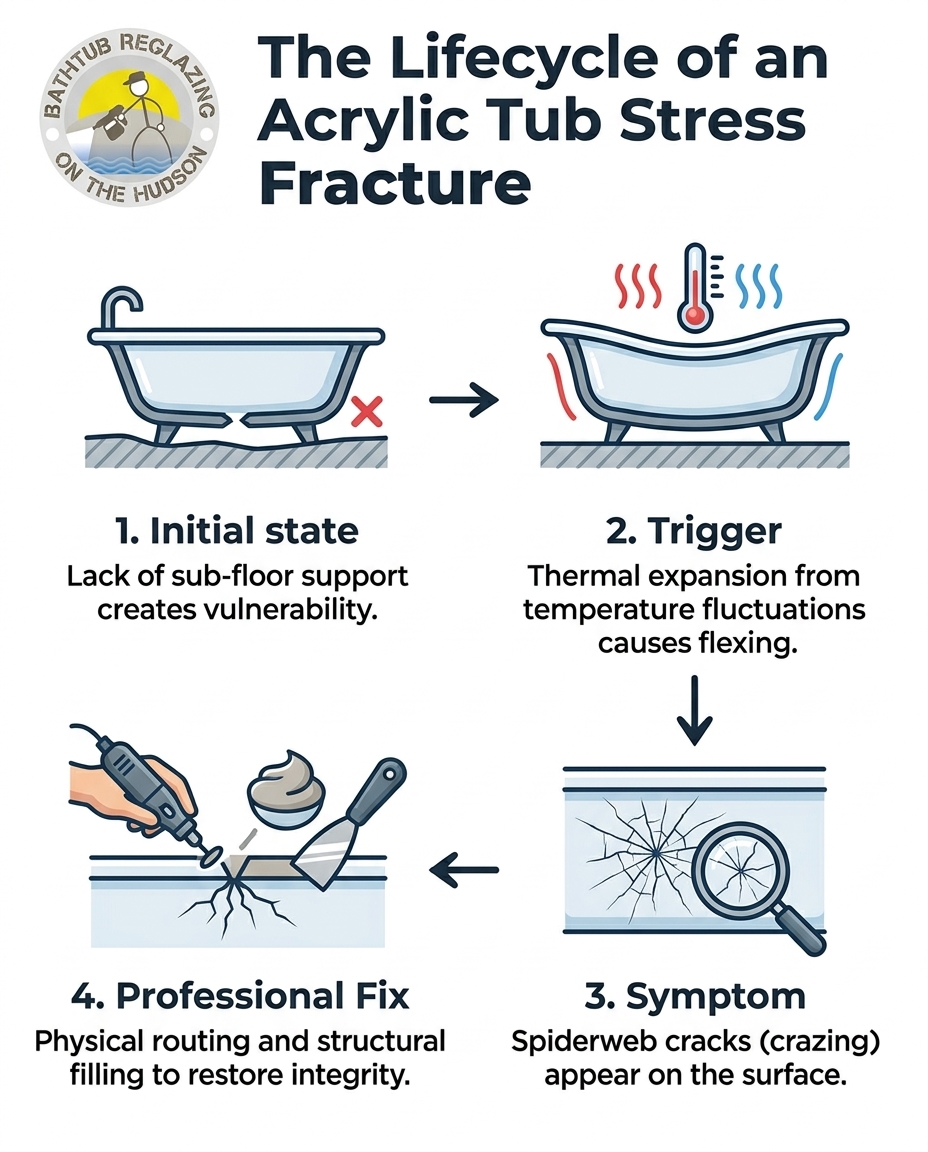
Thermal expansion alone usually is not enough to crack a well-installed tub. The true catalyst for spiderweb cracks is a lack of proper sub-floor support. When modern acrylic bathtubs are installed, they require a rigid base—often a 1-to-2-inch mortar bed or high-density foam—between the bottom of the tub and the wooden sub-floor. If this support is missing, insufficient, or has degraded over time, the tub floor is left suspended in the air.
• Weight deflection: Every time someone steps into an unsupported tub, the floor bows downward under their weight.
• Thermal stress: As the tub bows downward, the hot water causes the material to expand simultaneously.
• Material fatigue: The combination of physical bending and thermal stretching pushes the acrylic past its breaking point.
• Fracture formation: The surface finally gives way, creating a network of fine, intersecting lines known as spiderweb cracks.
These cracks are rarely the result of a single dropped shampoo bottle. They are the cumulative symptom of continuous movement and thermal stress over months or years.
Cosmetic Crazing vs. Structural Stress Fractures
During our diagnostic phase, the most important distinction our technicians must make is whether the web-like lines are merely cosmetic crazing or deep structural stress fractures. Treating a structural fracture like a cosmetic scratch will lead to a failed restoration, while over-treating minor crazing adds unnecessary time to the project.
Defining Cosmetic Crazing
Cosmetic crazing consists of shallow surface scratches or glaze wear that does not penetrate the structural layer of the tub. This type of wear is often caused by years of abrasive cleaning pads, harsh chemical cleaners, or minor surface impacts. Because crazing only affects the uppermost micro-layer of the acrylic, the tub remains structurally sound. The floor does not flex excessively, and the lines do not open or close when weight is applied.
Identifying Structural Stress Fractures
Structural stress fractures go much deeper. They penetrate through the 1/8th-inch acrylic surface and deep into the fiberglass backing, compromising the structural integrity of modern acrylic bathtubs. When a technician presses down on the tub floor near a structural fracture, the crack will visibly widen as the floor deflects. Water can seep through these deep fissures, leading to mold growth, water damage in the sub-floor, and delamination of the tub's layers.
• Depth of Damage — Cosmetic Crazing: Shallow; confined to the surface glaze. — Structural Stress Fractures: Deep; penetrates into the fiberglass backing.
• Response to Weight — Cosmetic Crazing: Cracks remain static when pressed. — Structural Stress Fractures: Cracks widen or shift under physical pressure.
• Primary Cause — Cosmetic Crazing: Abrasive cleaners, age, surface wear. — Structural Stress Fractures: Lack of base support, thermal expansion, flexing.
• Required Treatment — Cosmetic Crazing: Standard etching and resurfacing. — Structural Stress Fractures: Physical routing and structural filling.
Our professional diagnostic process involves checking for sub-floor flex, testing the depth of the spiderweb cracks with specialized instruments, and assessing the overall stability of the fixture. Severe structural issues often require more intensive repair strategies before any surface work begins. Much like the process of repairing massive tub chips before resurfacing, diagnosing and treating deep fractures is a prerequisite for a successful finish.
Why Cheap Cosmetic Band-Aids Fail During Temperature Shifts
Homeowners often attempt to resolve spiderweb cracks using DIY epoxy kits or cheap roll-on paints found at hardware stores. The logic seems sound: if there is a crack, fill it with paint or chemical adhesive to seal it. Unfortunately, this approach completely ignores the physics of how bathtubs behave in a real-world environment.
The Chemistry of Adhesion vs. Cohesion
Applying a chemical bond or DIY paint directly over spiderweb cracks is only a temporary cover-up. These consumer-grade epoxies rely entirely on surface adhesion. They sit on top of the crack like a piece of tape. However, because the underlying structural flex has not been addressed, the two sides of the crack will continue to move independently every time someone steps into the tub.
Mid-fall temperature drops will inevitably cause the tub to expand and contract. As the hot water hits the cold acrylic, the material stretches. The cheap cosmetic patch, which usually lacks the elasticity of the original acrylic, cannot stretch at the same rate. The shear force causes the bond to break. Once the seal is broken, water seeps underneath the patch, accelerating the failure.
The Chain Reaction of a Failed Coating
Failing to address the root cause leads to a predictable chain reaction: bubbling, peeling, and the need for a complete do-over. One local Peekskill homeowner we assisted last fall experienced this firsthand when a previous paint job bubbled and failed completely. The previous contractors had simply rolled a cosmetic coating over existing stress lines without diagnosing the structural flex. The bubbling issue required our professional team to step in, strip the failed 1/16th-inch coating entirely, correctly fix the underlying fractures, and stand by the work with a proper, professional finish.
The hard truth: True longevity requires a stable, structural anchor for the new finish. A surface coating is only as strong as the substrate it is bonded to. If the substrate is cracked and moving, the coating will inevitably fail.
The Necessity of Physical Routing for Permanent Repair
When our professional technicians at Bathtub Reglazing On The Hudson encounter structural stress fractures in modern acrylic bathtubs, we do not reach for a paintbrush. We reach for mechanical routing tools. The professional methodology for addressing stress fractures requires physically altering the crack to create a permanent, anchored repair.
The Mechanical Routing Process
Physical routing involves using specialized grinding or rotary tools to carve out the spiderweb cracks. Rather than leaving the crack as a microscopic hairline fissure, the technician physically widens and deepens it, creating a distinct "V" or "U" shaped channel—typically 1/4-inch wide—in the floor of the tub. This physical routing is non-negotiable for modern acrylic bathtubs for several reasons:
1. Removing compromised material: The edges of a stress fracture are weak, frayed, and structurally unsound. Routing cuts away this dead material, exposing fresh, solid acrylic and fiberglass.
2. Increasing surface area: A hairline crack has almost no internal surface area for a filler to grip. A 1/4-inch routed channel increases the bonding surface area exponentially.
3. Creating a mechanical lock: By shaping the channel correctly, the repair compound physically locks into the surrounding material, rather than just resting on top of it.
This meticulous process of actually routing out stress fractures prior to resurfacing ensures long-lasting durability. It stands in stark contrast to inferior methods that rely solely on chemical adhesion, light sanding, or wipe-on primers. Creating this channel provides the necessary depth for structural fillers to anchor securely, bridging the gap with a material that can withstand the daily rigors of thermal expansion and weight deflection.
Structural Filling and Comprehensive Surface Preparation
Once the spiderweb cracks have been mechanically routed, the tub is ready for structural filling. This phase bridges the gap between demolition and restoration, transforming a compromised, routed trench back into a smooth, continuous surface.
Applying Advanced Structural Compounds
Our team fills the routed channels with specialized structural compounds designed specifically for modern acrylic bathtubs. Unlike standard body fillers or cheap DIY putties, these professional-grade resins are engineered to mimic the physical properties of the tub itself. They cure to an incredibly hard finish, yet retain a microscopic level of flexibility. This elasticity is fundamental because it allows the repaired area to flex naturally with the tub during temperature shifts, preventing the repair from popping out under pressure.
The curing and leveling process requires strict attention to detail. The compound must be applied slightly higher than the surrounding tub floor, allowed to fully cure, and then meticulously sanded down until it is perfectly flush with the original acrylic. If you run your hand over a properly filled and leveled repair, you should not be able to feel where the original tub ends and the repair begins.
The Standard for Full Restorations
This comprehensive preparation is a fundamental component of all full bathtub restorations, ensuring the new surface bonds perfectly without any underlying weaknesses. This level of meticulous care applies to any significant tub damage. In a recent mid-fall restoration in a 1990s split-level home, a tub had a large piece of bathtub glaze chipped off right near a high-stress zone. The repair required cleaning up old chipped grout, replacing it, structurally filling the deep void, and then proceeding with the reglaze. The outcome ensured the tub looked and worked better than before, with a fantastic, durable finish.
Professional refinishers apply this same level of detail when performing adjacent upgrades in the space, such as bathroom tile reglazing, maintaining a high standard across all surfaces in the room.
Ensuring Long-Term Durability for Your Acrylic Bathtub
At Bathtub Reglazing On The Hudson, we know that diagnosing and treating spiderweb cracks requires more than a passing glance. A professional explanation of the damage and a proper routing methodology are the keys to permanently repairing the structural integrity of your fixture. Cutting corners during the preparation phase only guarantees that the new finish will fail when put under stress.
Addressing spiderweb cracks thoroughly before the deep freezes of winter set in ensures a flawless, long-lasting finish that can withstand the thermal cycling of the colder months. If you notice fine lines developing in your fixture, do not wait for them to widen into deep structural failures. Seek a professional diagnostic inspection to evaluate the health of your tub, ensuring that any subsequent resurfacing work rests on a solid, permanent foundation.
Frequently Asked Questions
Can you reglaze a tub with spiderweb cracks?
Yes, but the cracks must be structurally repaired first. A professional will diagnose the depth of the cracks to determine if they are cosmetic or structural. If they are deep stress fractures, they must be physically routed out and filled with a structural compound before any reglazing materials are applied. Simply painting over the cracks will cause the new glaze to fail quickly.
What causes spiderweb cracks in modern acrylic tubs?
These cracks are typically caused by a combination of thermal expansion and a lack of sub-floor support. As hot water hits the tub, the acrylic expands, and the weight of the bather causes the unsupported floor to flex. Over time, this constant bending and thermal cycling causes the plastic polymer to fatigue and fracture into web-like patterns.
How do professionals fix hairline cracks in an acrylic bathtub?
Professionals, like our team, fix hairline stress fractures by using rotary tools to mechanically route out the crack into a 1/4-inch "V" or "U" shaped channel. This removes the compromised material and provides a wide surface area for repair. The channel is then filled with a specialized, flexible structural resin, allowed to cure, and sanded perfectly flush before the final resurfacing begins.
Will a DIY epoxy patch kit permanently fix tub cracks?
No, DIY epoxy kits generally act as temporary band-aids. Because they rely entirely on surface adhesion and do not address the underlying flex of the tub floor, they eventually fail. As the tub expands and contracts with temperature changes, the shear forces will cause the rigid DIY epoxy to bubble, peel, or pop out completely.
Why do bathtub stress fractures seem to worsen during the fall and winter?
Mid-fall temperature drops and the activation of home heating systems create extreme temperature swings in the bathroom. The tub sits in a cold ambient environment and is suddenly exposed to scalding hot shower water. This rapid thermal shock forces the acrylic to expand aggressively, putting immense stress on existing weak points and causing minor cracks to spread.
How can I tell if my tub crack is just cosmetic crazing or a structural issue?
Cosmetic crazing appears as very shallow surface scratches that do not change when you press on them. Structural stress fractures are deeper, often penetrating past the 1/8th-inch acrylic layer, and typically widen or shift when you apply physical pressure to the tub floor. A professional diagnostic inspection is the safest way to determine the exact depth and severity of the material failure.
Schedule Service
Thank you! Your submission has been received!
Oops! Something went wrong while submitting the form.
Other Blogs
Customer Testimonials
Hear what customers are saying about our professional refinishing and outstanding results.

Can’t say enough about Maurice. From start to finish great communication his work is incredible and he stands by it very competitive pricing just all-around good guy the work was done quick and kept very clean and our brand new bathroom
Joey N.
We had a large piece of bathtub glaze chip off. Maurice came in and did a fantastic job. It now looks and works better than before. He went above and beyond the contract by cleaning up the old chipped grout between the tub and the tiles and replacing with brand new.
Bozidar J.
Maurice did a great job on my tub. It looks brand new.
Steven S.