
The Myth of the Quick Fix: Why Surface Prep Dictates Reglazing Success
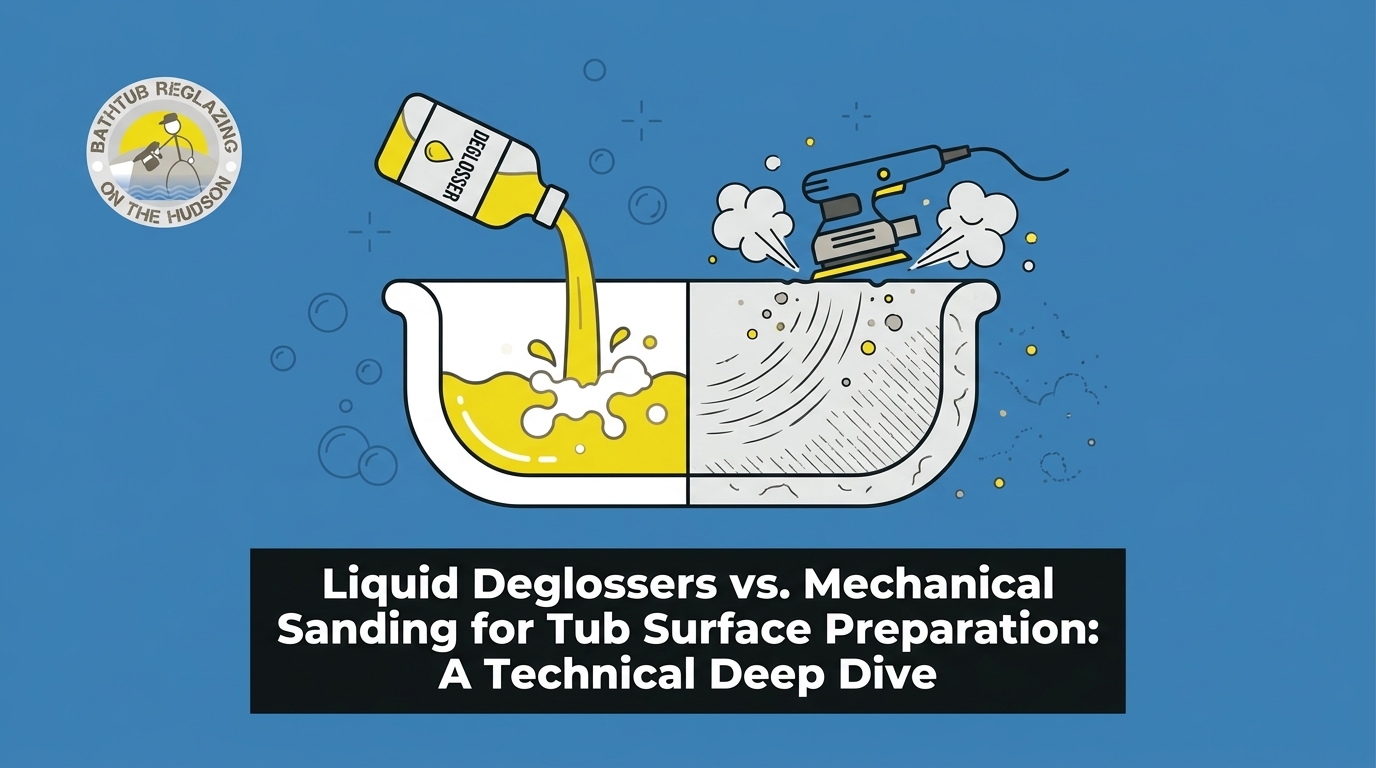
Wiping down a bathroom fixture with harsh chemical solvents will not guarantee a permanent bond, which is why understanding the technical differences between Liquid Deglossers vs. Mechanical Sanding for Tub Surface Preparation is critical for any property owner. A pervasive myth in the home improvement space suggests that applying a liquid chemical wash is enough to prepare an old, worn fixture for a brand-new coating. This misconception often leads to one of the most frustrating outcomes in property maintenance: premature peeling and complete coating failure within months of application.
The concrete problem stems from a fundamental misunderstanding of how modern industrial coatings adhere to slick, factory-fired surfaces. At Bathtub Reglazing On The Hudson, our team often sees homeowners scheduling early fall bathroom renovations who rush the process, hoping to complete updates quickly before the holiday hosting season begins. In this rush, chemical shortcuts seem appealing. However, the decision point comes down to understanding why rigorous physical abrasion is a non-negotiable step for lasting results. A proper bathtub reglazing requires more than just a clean surface; it requires a structurally modified substrate. Skipping this essential step in favor of a fast chemical wipe-down virtually guarantees that the new finish will detach, bubble, and fail under everyday use.
The Science of Adhesion on Non-Porous Surfaces
To understand why surface preparation is the most critical phase of professional tub refinishing, one must first look at the molecular structure of the fixtures themselves. Bathtubs are typically constructed from porcelain over cast iron, porcelain over steel, or molded fiberglass coated with a dense gel coat. These materials share a common engineering goal: they are inherently non-porous and incredibly slick. They are designed specifically in a factory environment to repel moisture, resist mineral stains, and prevent anything from sticking to them.
Because these surfaces are designed to repel foreign substances, applying a new liquid coating directly on top of them defies basic physics. For a new glaze to adhere permanently, the surface must possess what the coating industry refers to as a "mechanical tooth." A mechanical tooth is a microscopic physical profile consisting of thousands of tiny peaks and valleys scored into the original glaze. This rough profile allows the new liquid coating to flow into the microscopic crevices, lock into place, and cure as a physically integrated layer rather than just sitting superficially on top.
The mechanics of a physical bond:
• Surface area expansion: Micro-abrasions drastically increase the total surface area available for the new coating to grip.
• Physical interlocking: The cured glaze acts like thousands of microscopic anchors embedded into the original substrate.
• Shear strength: A physically anchored coating resists the lateral forces of standing water, shifting weights, and scrubbing.
Why Chemical Etching Falls Short
Chemical etching alters the surface tension of the fixture but fails to create the sufficient depth profile required for industrial adhesion. Liquid deglossers primarily function as heavy-duty degreasers. They excel at stripping away years of built-up body oils, stubborn soap scum, and hard water mineral deposits. While removing these contaminants is an important preliminary cleaning step, it does not restructure the substrate.
Standard coating industry adhesion principles demand physical micro-abrasions to support a long-term bond on non-porous materials. A chemical wash might leave the tub looking slightly dull to the naked eye, but under a microscope, the surface remains far too smooth and shallow to anchor a high-build synthetic glaze permanently.
Liquid Deglossers: The Chemical Shortcut and Its Limitations
Liquid deglossers, sometimes marketed as "liquid sandpaper," are incredibly popular in general remodeling because they save a tremendous amount of time and labor. The chemical mechanism behind these products relies on strong solvents—such as ethyl acetate, naphtha, or heavy alcohols—to soften and dull existing finishes without the airborne dust associated with physical sanding.
While these chemical agents have a legitimate place in certain applications, their limitations become glaringly obvious when applied to bathroom fixtures. Liquid deglossers work exceptionally well on softer, porous materials. For example, if a contractor is painting old wood kitchen cabinets, a liquid deglosser will effectively melt the existing varnish, allowing the new paint to bond with the porous wood grain beneath. Wood is naturally absorbent, so the chemical softening is often sufficient.
However, bathtubs do not have a porous grain. You cannot chemically soften factory-baked porcelain or high-density acrylic with standard deglossers. The hard glaze remains completely impenetrable to these solvents. The liquid simply evaporates, leaving behind a clean but fundamentally smooth surface.
Key limitations of liquid deglossers on bathtubs:
• No physical abrasion: They cannot scratch or score high-fired porcelain or cast iron.
• False sense of security: The surface may feel "squeaky clean," tricking inexperienced workers into thinking it is ready for paint.
• Moisture vulnerability: Because the bond is only superficial, high-moisture environments will easily penetrate the coating barrier.
• Inadequate for high-wear zones: The bottom of a bathtub endures constant foot traffic and water pressure, which easily shears off a superficially bonded coating.
Ultimately, while liquid deglossers might be appropriate for a living room bookshelf, they are entirely insufficient for high-moisture, high-wear, non-porous bathroom fixtures.
Mechanical Sanding: Creating the Physical Micro-Abrasion
The professional standard for preparing a bathtub relies on rigorous mechanical sanding. This process involves specialized orbital sanding equipment and specific grit progressions to physically score the tub's surface. Professionals do not rely on chemical shortcuts; instead, they manually restructure the top layer of the fixture to guarantee that the new glaze has a permanent mechanical anchor.
The meticulous nature of this prep work cannot be overstated. Technicians systematically work across every square inch of the basin, the walls, and the complex curves of the fixture. They pay special attention to the drain area and the corners, ensuring sharp edges and a uniform profile across the entire tub. This physical scoring creates thousands of microscopic gripping points for the new glaze.
In one real-world scenario our crew tackled during a past summer project here in Peekskill, a bathtub had suffered severe discoloration after 25 years of direct sunlight exposure. Because our team prepped the surface with meticulous mechanical sanding, the glazing job was completed efficiently in a single day. The finished product fully restored the fixture's original beauty without the risk of future peeling, proving that doing the foundational work correctly yields immediate and lasting aesthetic results.
This rigorous preparation standard reflects a strict professional commitment to quality over speed. Refusing to use labor-saving chemical shortcuts is a deliberate standard that protects the property owner's investment. Furthermore, this exact same physical profiling protocol applies to adjacent surfaces. For instance, when installing or integrating a bathtub tile surround, the adjoining ceramic tiles must also be mechanically profiled if they are to receive any integrated coating or bonding agents, ensuring all adjacent surfaces act as a unified, water-tight system.
Thermal Stress and Coating Survival in Historic Homes
The method of surface preparation directly dictates how well a newly applied coating will survive the inevitable physics of seasonal thermal expansion. Bathroom fixtures are subjected to extreme temperature fluctuations daily. When a resident turns on a hot shower, the rapid influx of heat causes the bathtub material to expand. Once the water drains and the room cools, the material contracts. This constant expansion and contraction places immense thermal stress on the surface coating.
This dynamic is especially pronounced in specific regional architectures. For example, in our years servicing Peekskill and the greater Hudson Valley, we frequently see historic homes experience significant indoor humidity drops during the freezing winter months, followed by intense humidity spikes in the summer. These older homes often feature drafty bathrooms that chill cast iron tubs to the core overnight, only to be hit with 110-degree water the next morning. This extreme thermal shock requires an incredibly resilient bond.
How thermal stress interacts with prep methods:
• The Chemical Bond Failure: A weak chemical bond acts like a rigid sticker placed on a balloon. As the tub expands under hot water, the superficial bond cannot stretch with the substrate. The sheer force breaks the bond, leading to immediate delamination.
• The Mechanical Bond Success: A strong mechanical bond, anchored deep into the physical "tooth" of the sanded porcelain, flexes and holds. The thousands of microscopic anchors distribute the thermal stress evenly across the fixture, allowing the glaze to expand and contract seamlessly with the tub.
These same physical laws apply to the entire wet area. Adjacent surfaces, which may require bathroom tile reglazing, also undergo these exact same thermal shifts and demand identical mechanical prep standards to survive the regional climate shifts.
The Real Cost of Shortcuts: Premature Peeling and Adhesion Failure
The consequences of improper preparation are severe, costly, and entirely avoidable. When a contractor or a DIY enthusiast relies solely on liquid deglossers, coating failure and premature peeling almost always occur within the first twelve months of use. Once the superficial bond breaks, the deterioration accelerates rapidly.
The visual signs of adhesion failure are unmistakable. It typically begins with microscopic bubbling near the drain or along the floor of the tub where water pools. These bubbles indicate that water intrusion has occurred beneath the new glaze. As the water expands and contracts, the bubbles burst, leading to large-scale flaking. Sheets of the new coating will begin to peel away, exposing the original, dull tub underneath and creating an unsanitary environment where mold and bacteria can thrive in the jagged edges of the peeling paint.
Another common issue arises when previous coating attempts fail due to poor chemical prep. In one recent project, our team was called to help a homeowner dealing with severe bubbling on their bathtub surface after a previous painter's chemical-prep job completely failed. Correcting this highly difficult job required our professionals to completely strip the bubbled layers, clean the raw substrate, and return to rigorous mechanical sanding to fix the issue permanently—demonstrating how a failure to prep correctly the first time doubles the labor required to fix it later.
Repairing a failed, chemically-prepped tub is a significant undertaking. The entire failed coating must be chemically stripped and manually scraped away before proper mechanical sanding can even begin. Homeowners dealing with severe peeling often end up comparing bathtub reglazing vs. replacement, assuming that reglazing simply does not work. In reality, the issue was never the reglazing process itself—it was simply the poor, shortcut-driven surface preparation.
Side-by-Side Comparison: Mechanical Sanding vs. Chemical Deglossing
To synthesize the technical mechanics of surface preparation, it is helpful to look at a direct comparison of the two methodologies. Understanding these differences empowers property owners to ask the right questions when hiring a professional.
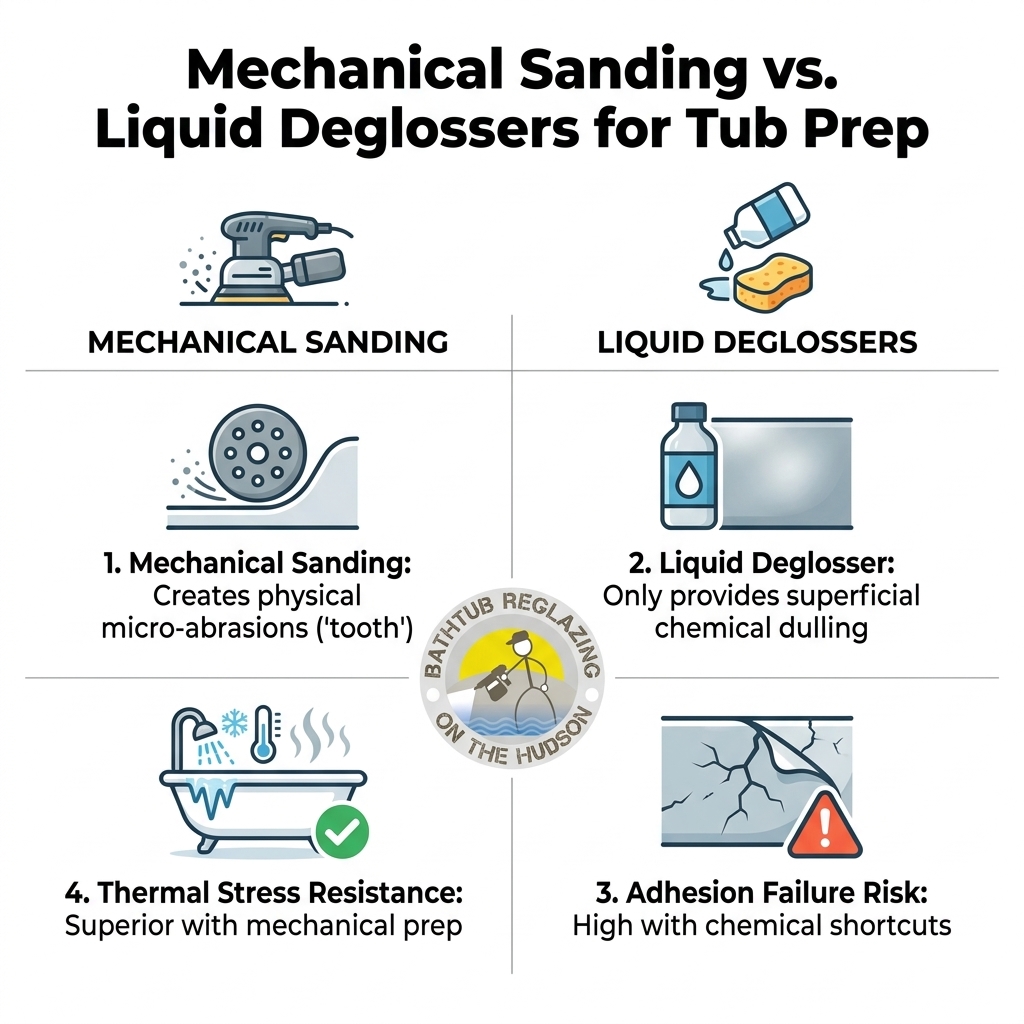
• Method of Action — Mechanical Sanding: Physical abrasion using specialized orbital equipment and specific grit sizes. — Liquid Deglosser (Chemical): Chemical solvent application to clean and superficially dull the finish.
• Surface Profile Achieved — Mechanical Sanding: Deep microscopic "tooth" with thousands of physical anchor points. — Liquid Deglosser (Chemical): Superficial dulling with no significant physical depth or texture.
• Durability under Thermal Stress — Mechanical Sanding: Excellent. The mechanical anchors flex and hold during temperature shifts. — Liquid Deglosser (Chemical): Poor. The superficial bond easily shears and snaps under thermal expansion.
• Risk of Premature Peeling — Mechanical Sanding: Extremely Low. The coating is physically locked into the substrate. — Liquid Deglosser (Chemical): High. Water intrusion easily breaks the weak chemical surface tension.
• Professional Standard — Mechanical Sanding: Mandated. Required by industry standards for all non-porous bathroom fixtures. — Liquid Deglosser (Chemical): Discouraged. Unsuitable for high-moisture, non-porous surfaces like porcelain.
Frequently Asked Questions
Why is my recently reglazed tub peeling?
A recently reglazed tub usually peels because the surface was not properly prepared before the new coating was applied. If the technician skipped mechanical sanding and relied only on chemical cleaners, the new glaze lacks the physical "tooth" needed to anchor it to the tub. Moisture eventually works its way under the weak bond, causing it to bubble and peel.
Can I use liquid sander deglosser on a fiberglass or porcelain bathtub?
Using a liquid deglosser on fiberglass or porcelain is highly discouraged for refinishing purposes. These materials are inherently non-porous, meaning the chemical solvents will only clean the surface rather than etch a deep profile into it. Without physical abrasion, any coating applied over the deglosser will eventually fail under the stress of daily water exposure.
Do professionals sand before reglazing a tub?
Yes, true professionals always sand a tub extensively before applying a new glaze. They utilize specialized orbital sanding equipment and specific grit progressions to physically score the entire surface, including the complex curves and corners. This rigorous mechanical prep is the only way to guarantee a permanent, long-lasting bond.
How do you prep a bathtub for refinishing without damaging it?
Proper preparation involves controlled mechanical sanding that breaks the glossy surface tension without compromising the structural integrity of the cast iron or fiberglass beneath. Professionals know exactly which grit sizes to use to create the necessary micro-abrasions. This process removes the slick factory glaze and creates a uniform profile without causing structural damage to the fixture.
What is the difference between chemical etching and mechanical sanding?
Chemical etching uses acidic compounds or heavy solvents to alter the surface tension and remove contaminants, leaving a superficially clean finish. Mechanical sanding uses physical friction to carve microscopic peaks and valleys into the hard material. While chemical etching cleans the tub, only mechanical sanding creates the physical depth required to anchor a high-build industrial coating.
How long should a properly sanded and reglazed tub last?
When a bathtub is properly prepped using rigorous mechanical sanding and coated with professional-grade materials, the finish can easily last for many years under normal use. The physical bond withstands daily thermal expansion, heavy water flow, and standard cleaning routines, making it a highly durable and cost-effective alternative to full tub replacement.
Ensuring a Lasting Finish
Understanding the fundamental differences between chemical shortcuts and proper mechanical preparation is the best way to protect your bathroom renovation investment. Armed with a clear, technical understanding of the adhesion process, you can confidently verify that your chosen professional—like our dedicated team at Bathtub Reglazing On The Hudson—utilizes the rigorous sanding techniques required to deliver a durable, flawless finish that will easily withstand the demands of daily use.
Schedule Service
Thank you! Your submission has been received!
Oops! Something went wrong while submitting the form.
Other Blogs
Customer Testimonials
Hear what customers are saying about our professional refinishing and outstanding results.

Can’t say enough about Maurice. From start to finish great communication his work is incredible and he stands by it very competitive pricing just all-around good guy the work was done quick and kept very clean and our brand new bathroom
Joey N.
We had a large piece of bathtub glaze chip off. Maurice came in and did a fantastic job. It now looks and works better than before. He went above and beyond the contract by cleaning up the old chipped grout between the tub and the tiles and replacing with brand new.
Bozidar J.
Maurice did a great job on my tub. It looks brand new.
Steven S.