

Is Moving Your Antique Tub Worth the Risk?
When you are weighing the benefits of refinishing a clawfoot tub in place vs. transporting it to a shop, the biggest question usually comes down to property risk. Here at Bathtub Reglazing On The Hudson, our team typically sees homeowners struggling with how to safely restore a heavy, aging bathroom centerpiece without causing severe damage to their older Peekskill, NY properties in the process. Many homeowners assume that sending a fixture away to a controlled environment is the only way to get a flawless finish. However, the journey from your upstairs bathroom to an off-site facility is fraught with immense physical and logistical hazards.
Choosing the right method means comparing the logistical nightmare of extracting a heavy fixture against the safety and efficiency of professional on-site restoration. If you are exploring antique tub restorations, understanding the true cost of transportation in terms of property risk and labor is critical. By looking closely at the labor required, the potential for collateral damage, and the final finish quality, you can make a confident decision that protects both your 300+ lb antique cast iron clawfoot tub and your home's historic charm.
The Logistical Reality of Moving a 300+ lb Antique Cast Iron Clawfoot Tub
Before deciding to move a vintage fixture, it is essential to understand the sheer physical challenge involved. A standard 5-foot roll-rim vintage cast iron clawfoot tub typically weighs between 300 and 400 pounds. This is not a hollow, modern acrylic shell; it is a dense, unyielding block of iron that requires significant manpower simply to shift across a level floor, let alone navigate through a house.
The Weight and Maneuverability Challenge
The density of cast iron makes these tubs incredibly difficult to grip and maneuver. Because the weight is often unevenly distributed—especially around the sloped backrest and the heavy rolled rim—lifting a 300+ lb antique cast iron clawfoot tub requires specialized dollies, heavy-duty straps, and a crew of experienced movers. Even with the right equipment, a single slip can result in severe injury to the workers or catastrophic damage to the floor joists beneath.
Plumbing and Architectural Hurdles
Getting the tub unhooked and out of the bathroom introduces a second layer of complexity. In our experience working in historic homes built between 1890 and 1930, the plumbing connected to these fixtures is often just as vintage as the tub itself. When deciding between reglazing and replacing your tub or moving it off-site, you must factor in the extraction requirements.
1. Disconnecting fragile plumbing: Older brass or galvanized steel pipes are prone to snapping or crumbling when disturbed. Plumbers must carefully disconnect the drain and overflow without breaking the main lines hidden beneath the floorboards.
2. Removing the claw feet: To lower the tub's profile and make it slightly easier to slide, the cast iron feet usually need to be unbolted. These bolts are often rusted in place after decades of moisture exposure, requiring careful extraction to avoid snapping the cast iron mounting lugs.
3. Navigating narrow doorways: Standard doorway widths in historic homes are frequently too narrow to accommodate a 30-inch wide cast iron tub. In many cases, homeowners are forced to remove the bathroom door, the hinges, and sometimes even the wooden door frame itself just to squeeze the tub into the hallway.
4. Clearing the path: Once out of the bathroom, every piece of furniture, rug, and wall hanging in the transport path must be removed to give the moving crew enough clearance to pivot the massive fixture.
Contrast this massive extraction effort with the broader considerations of a bathroom renovation. If your goal is simply to restore the tub's surface, dismantling your bathroom architecture to get it out the door is an extreme and often unnecessary measure.
Property Risks: Navigating Hudson Valley Historic Homes with Narrow Staircases
The challenges of moving a heavy fixture multiply exponentially once the tub leaves the bathroom, particularly in regions known for their older architecture. Hudson Valley historic homes with narrow staircases—often featuring tight 36-inch widths and sharp 90-degree turns typical of 1920s colonials—present unique and severe hazards when it comes to extracting heavy, bulky items.
The Staircase Bottleneck
Historic homes were not built with modern moving logistics in mind. They frequently feature steep, narrow, and turning staircases with tight landings. Maneuvering a 300+ pound block of iron down a wooden staircase requires the moving crew to tilt the tub at extreme angles. If the crew loses their grip, the tub becomes a dangerous, unstoppable force.
The collateral damage risks include:
• Scratched and gouged floors: Original hardwood floors are easily dented or deeply scratched if a cast iron tub is dropped or dragged even a fraction of an inch.
• Dented and scraped walls: Navigating tight corners often results in the tub scraping against plaster walls, leaving deep gouges that require drywall or plaster repair.
• Broken banisters and trim: Historic banisters, newel posts, and decorative trim are highly vulnerable to being crushed or snapped if the tub shifts unexpectedly during the descent.
Exterior Hazards in the Colder Months
The property risks do not end once the tub reaches the ground floor. Transporting the fixture out to a moving truck introduces serious weather-related liabilities. There is extreme danger in transporting a 300+ pound tub down exterior stairs during icy or wet Hudson Valley fall conditions, especially as October morning frosts begin to settle. A slick stone step or a frost-covered wooden porch can easily cause a mover to slip, risking severe physical injury and permanent damage to the antique tub if it crashes to the ground.
Because of these severe risks, our specialized expertise at Bathtub Reglazing On The Hudson focuses heavily on zero collateral damage. The physical risk to the property and the liability of the move almost always outweigh the perceived benefits of a controlled off-site shop environment. Preserving the integrity of your historic home should be the top priority.
The In-Place Refinishing Advantage for Antique Fixtures
Fortunately, you do not have to dismantle your home to achieve a beautiful restoration. Professional in-place bathtub reglazing eliminates the moving logistics entirely by restoring the tub exactly where it sits. This method prioritizes property preservation while delivering exceptional results.
Advanced Masking and Property Protection
The foundation of in-place restoration is meticulous preparation. Technicians do not just start spraying; they transform your bathroom into a localized, highly protected workspace. This is especially crucial in Hudson Valley historic homes with narrow staircases, where avoiding the transport process saves the surrounding architecture from impact damage.
• Heavy-duty masking: Every inch of the surrounding tile, flooring, vanity, and toilet is covered using 3M heavy-duty masking paper and 4-mil plastic drop cloths.
• Hardware protection: Faucets, showerheads, and drains are carefully taped off or temporarily removed to ensure no coating material adheres to the plumbing fixtures.
• Dust containment: The workspace is sealed off from the rest of the house to prevent any sanding dust or debris from migrating into bedrooms or hallways.
Ventilation and Odor Control
A common concern with in-home work is the smell of the coatings. Professional technicians use high-powered negative air machines and industrial exhaust systems. These systems pull the fumes directly out of the bathroom window and vent them safely outside, preventing odors from lingering in your living spaces. The bathroom remains clean, controlled, and undamaged throughout the entire process.
This approach consistently yields outstanding results without the collateral risks. For example, our team recently worked on a heavily mineral-stained 1910 Crane Co. porcelain tub earlier this October. The technician turned the stained fixture into a spotless, shiny, beautiful white bathtub while meticulously protecting the surrounding bathroom space. The outcome exceeded expectations, delivering a pristine fixture without a single tile or doorframe being disturbed.
Finish Quality: Shop Spray Booth vs. Professional In-Home Restoration
A persistent myth in the restoration industry is that a tub must be taken to a shop to achieve a high-quality finish. While off-site facilities have their benefits, modern professional tub refinishing techniques have advanced to the point where in-home results are virtually indistinguishable from factory finishes.
The Spray Booth Environment
It is true that a dedicated shop spray booth offers a highly controlled environment. These booths are dust-free, climate-controlled, and feature massive filtration systems. When a 300+ lb antique cast iron clawfoot tub is sprayed in a booth, the technician has 360-degree access to the fixture and does not have to worry about masking off surrounding walls. However, the tub still has to survive the journey there and back. Even a perfectly sprayed tub can be chipped or scratched when the moving crew wrestles it back up your narrow staircase.
Modern In-Home Techniques
We consistently find that professional in-home restoration relies on meticulous prep work that rivals shop conditions. The quality of the final finish is dictated almost entirely by how well the surface is cleaned, etched, and primed before the topcoat is applied.
The in-home prep process includes:
• Deep chemical cleaning: Stripping away decades of soap scum, hard water deposits, and body oils.
• Acid etching: Creating microscopic pores in the original porcelain so the new aerospace-grade aliphatic acrylic urethane coatings can form a permanent mechanical bond.
• Chip repair: Filling in deep gouges or rust spots with waterproof resin and sanding them perfectly flush with the surrounding surface.
• HVLP spraying: Using High Volume Low Pressure spray systems to apply fine, even layers of coating that self-level into a mirror-smooth finish.
With the right expertise, the final finish quality is flawless. Another recent fall restoration involved a tub suffering from general wear and tear. Because of the meticulous prep work performed right in the bathroom, the final product featured sharp edges and a mirror-smooth finish. The workspace remained completely spotless, leaving the fixture looking brand new with zero imperfections—all without the tub ever leaving the room.
Timeline and Convenience for Fall (Pre-Holiday Guest Bathroom Prep)
Beyond the physical risks and finish quality, the timeline of the project is a major deciding factor, especially when you are working against the calendar. If you are scheduling a fall (pre-holiday guest bathroom prep) project, turnaround time is critical.
The Transport Timeline
Transporting a tub to a shop is rarely a quick process. You must coordinate with a specialized moving crew to extract the tub, transport it to the facility, and wait your turn in the shop's queue. The actual stripping and spraying might only take a few days, but the logistical back-and-forth often results in the tub being out of your home for two to four weeks. During this time, your bathroom is an unusable construction zone, with exposed plumbing and missing fixtures—hardly ideal when you have family arriving for the holidays.
The In-Place Efficiency
In contrast, refinishing the tub in place is incredibly efficient. A professional technician arrives in the morning, preps the room, repairs the tub, applies the coatings, and cleans up the masking by the afternoon.
• Project duration: Typically completed in a single day.
• Curing time: Modern coatings often cure enough for light use within 24 to 48 hours at standard 68°F to 72°F room temperatures.
• Household disruption: Minimal. You do not have a construction zone lingering in your house for weeks.
This rapid turnaround is essential for fall (pre-holiday guest bathroom prep). It allows you to transform a worn-out guest bathroom into a welcoming, pristine space just days before your visitors arrive, completely avoiding the stress of extended downtime.
Making Your Decision: A Side-by-Side Summary
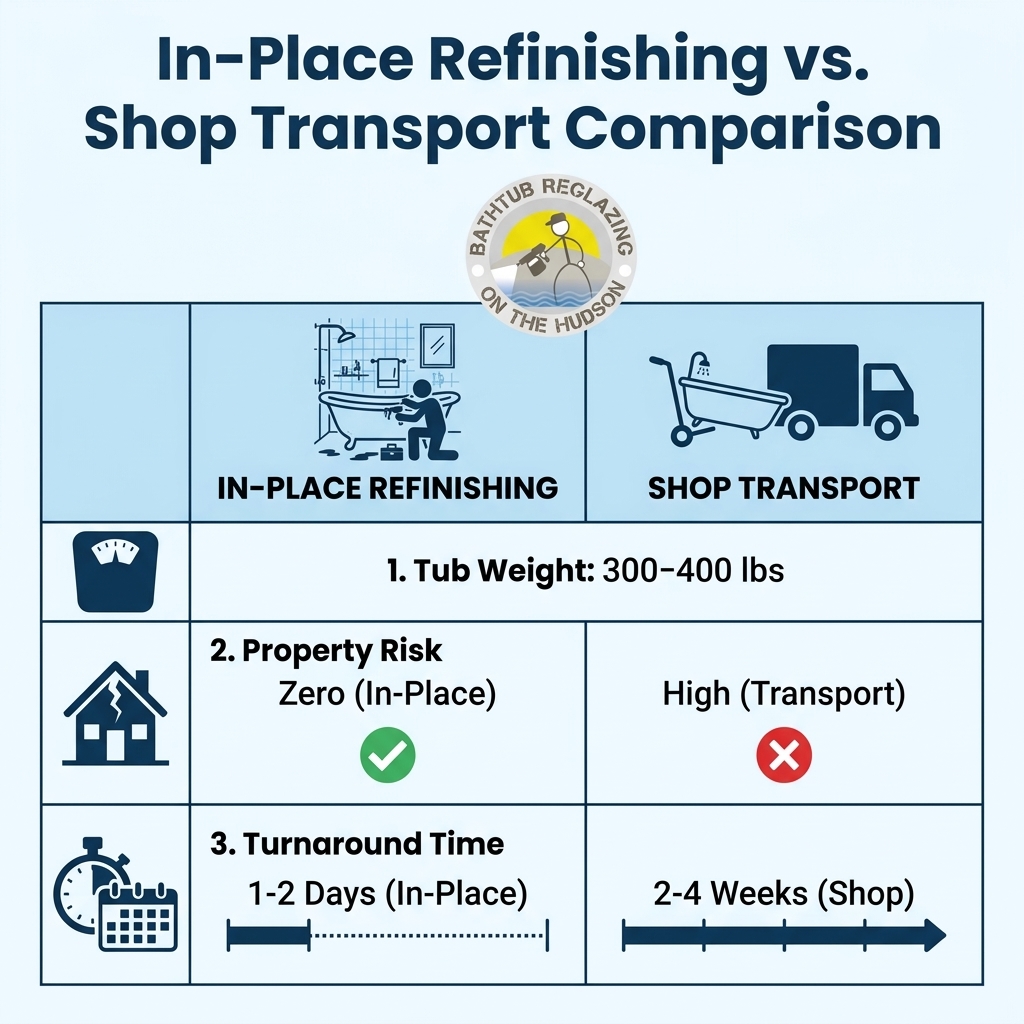
When it comes time to make your final choice, seeing the factors laid out clearly can help cut through the confusion. Moving a 300+ lb antique cast iron clawfoot tub is a massive undertaking, while restoring it where it sits offers a streamlined alternative. Here is a direct comparison of the two methods.
• Labor Effort — Moving to a Shop: Extremely High (requires specialized movers, plumbing disconnection, door removal) — Refinishing In-Place: Low (technician handles all prep and masking directly in the room)
• Property Risk — Moving to a Shop: Severe (high risk of scratched floors, dented walls, and broken banisters) — Refinishing In-Place: Zero (the heavy fixture never moves, preventing all transport-related damage)
• Turnaround Time — Moving to a Shop: 2 to 4 Weeks (coordinating movers, shop queues, and return delivery) — Refinishing In-Place: 1 to 2 Days (completed in a single day with short curing times)
• Finish Quality — Moving to a Shop: Excellent (but vulnerable to damage during the return trip up the stairs) — Refinishing In-Place: Excellent (mirror-smooth finish achieved safely in the bathroom)
For the vast majority of homeowners in historic properties, the severe risks to the home's architecture and the extended downtime make transporting the tub an unnecessary gamble.
Preserve Your Historic Home and Your Antique Tub Today
You can achieve a flawless, factory-grade tub finish without subjecting your home to the nightmare of moving heavy cast iron. In-place restoration is undeniably the safest choice for historic properties, protecting your narrow staircases, original floors, and vintage plumbing from catastrophic damage. If you are checking off your fall (pre-holiday guest bathroom prep) list, now is the time to act. Schedule your service before the holiday season arrives so your guest spaces are pristine and ready for visitors. Reach out today for a professional assessment, and let the experts at Bathtub Reglazing On The Hudson restore your antique tub safely, efficiently, and beautifully right where it belongs.
Frequently Asked Questions
Can you refinish a clawfoot tub without moving it?
Yes, professional technicians can fully refinish a clawfoot tub exactly where it sits in your bathroom. The process involves meticulously masking off the surrounding floors, walls, and fixtures to protect the room from overspray and dust. By completing the deep cleaning, etching, and spraying on-site, you completely avoid the physical risks and logistical headaches of trying to move the heavy fixture out of the house.
How heavy is a cast iron clawfoot tub?
An average empty vintage cast iron clawfoot tub, such as a standard 60-inch model, typically weighs between 300 and 400 pounds. Larger or uniquely shaped antique models can weigh even more. Because this weight is concentrated and difficult to grip, moving the tub requires specialized equipment, multiple strong workers, and extreme caution to avoid property damage or personal injury.
What are the risks of moving a cast iron tub out of an older home?
Moving a cast iron tub out of an older home carries severe risks of collateral damage to the property. Steep, narrow, and turning staircases make it incredibly difficult to maneuver the tub safely, frequently resulting in scratched hardwood floors, dented plaster walls, and broken banisters. Additionally, older, fragile plumbing connections can easily snap during the extraction process.
Does refinishing a tub in place smell?
There is a noticeable odor during the application phase, but professional refinishers use advanced ventilation systems to manage it safely. Technicians set up high-powered negative air machines that pull fumes directly out of a bathroom window and vent them outdoors. Once the coatings have cured—usually within 24 to 48 hours—the smell dissipates completely, leaving your home odor-free.
How do you move a cast iron tub down stairs?
Moving a cast iron tub down stairs requires specialized heavy-duty dollies, moving straps, and a coordinated crew of experienced professionals. The tub must often be tilted at steep angles to clear tight landings, and the surrounding walls and banisters should be padded to prevent damage. Because of the extreme physical danger and risk to the property, many experts recommend refinishing the tub in place instead.
How is a clawfoot tub reglazed safely in place?
A clawfoot tub is reglazed safely in place through a rigorous process of masking and ventilation. Technicians cover every inch of the surrounding bathroom with heavy-duty paper and plastic to protect against dust and overspray. The tub is then chemically cleaned, etched, repaired, and sprayed with aerospace-grade coatings, all while an exhaust system safely vents fumes outside, ensuring a clean and safe environment.
Schedule Service
Thank you! Your submission has been received!
Oops! Something went wrong while submitting the form.
Other Blogs
Customer Testimonials
Hear what customers are saying about our professional refinishing and outstanding results.

Can’t say enough about Maurice. From start to finish great communication his work is incredible and he stands by it very competitive pricing just all-around good guy the work was done quick and kept very clean and our brand new bathroom
Joey N.
We had a large piece of bathtub glaze chip off. Maurice came in and did a fantastic job. It now looks and works better than before. He went above and beyond the contract by cleaning up the old chipped grout between the tub and the tiles and replacing with brand new.
Bozidar J.
Maurice did a great job on my tub. It looks brand new.
Steven S.