

Evaluating Commercial Tub Reglazing Budgets for Your Facility
When property managers ask us, "What is the Average Cost to Reglaze a Tub in a Commercial Setting?" they usually already know that standard residential estimates simply do not apply to large-scale operations. In our years of experience serving Peekskill NY and the Hudson Valley, our team at Bathtub Reglazing On The Hudson frequently sees commercial facilities struggle to accurately project the cost of multi-unit bathroom updates without relying on flat, single-tub rates. The answer lies in understanding the complex variables that drive commercial project scoping. Facility managers need to refresh aging units efficiently, especially as the calendar turns toward October. This pre-winter indoor season prep is a critical deadline for properties looking to finalize renovations before peak travel and high-traffic indoor months arrive.
The primary decision point for property managers involves weighing the operational downtime of a full demolition and replacement against the strategic efficiencies of volume surface restoration. True commercial costs are dictated by variables like labor timing, environmental controls, and economies of scale, rather than a simple per-unit price tag. To accurately forecast your facility's budget, you need a comprehensive framework that evaluates how these logistical factors influence the bottom line. By partnering for professional bathtub reglazing, properties can transform their bathrooms while keeping strict control over operational disruptions.
The Shift from Residential to Commercial Scoping
When a homeowner updates a single bathroom, the budget is generally straightforward. However, commercial properties—such as motels, large-scale fitness centers, and multi-family housing complexes—operate under a completely different set of financial pressures. A commercial budget must account for the sheer volume of units, the coordination of multiple trades, and the impact of taking revenue-generating spaces out of service.
Instead of looking for a flat rate, successful facility managers analyze the total project impact. This means calculating the cost of materials and labor alongside the financial benefits of keeping the facility running smoothly. When you shift your perspective from a single-unit mindset to a comprehensive facility strategy, the true value of commercial restoration becomes clear.
The Hidden Cost Factor: Operational Downtime vs. Renovation Expenses
The most significant variable in any commercial bathroom update is rarely the cost of the physical materials or the labor itself—it is the hidden cost of operational downtime. Taking a commercial room, hotel suite, or gym locker room out of inventory for several days to a week for a full tub replacement creates a massive gap in daily earnings. For Peekskill and Hudson Valley commercial properties, every day a unit sits offline represents lost income that can never be recovered.
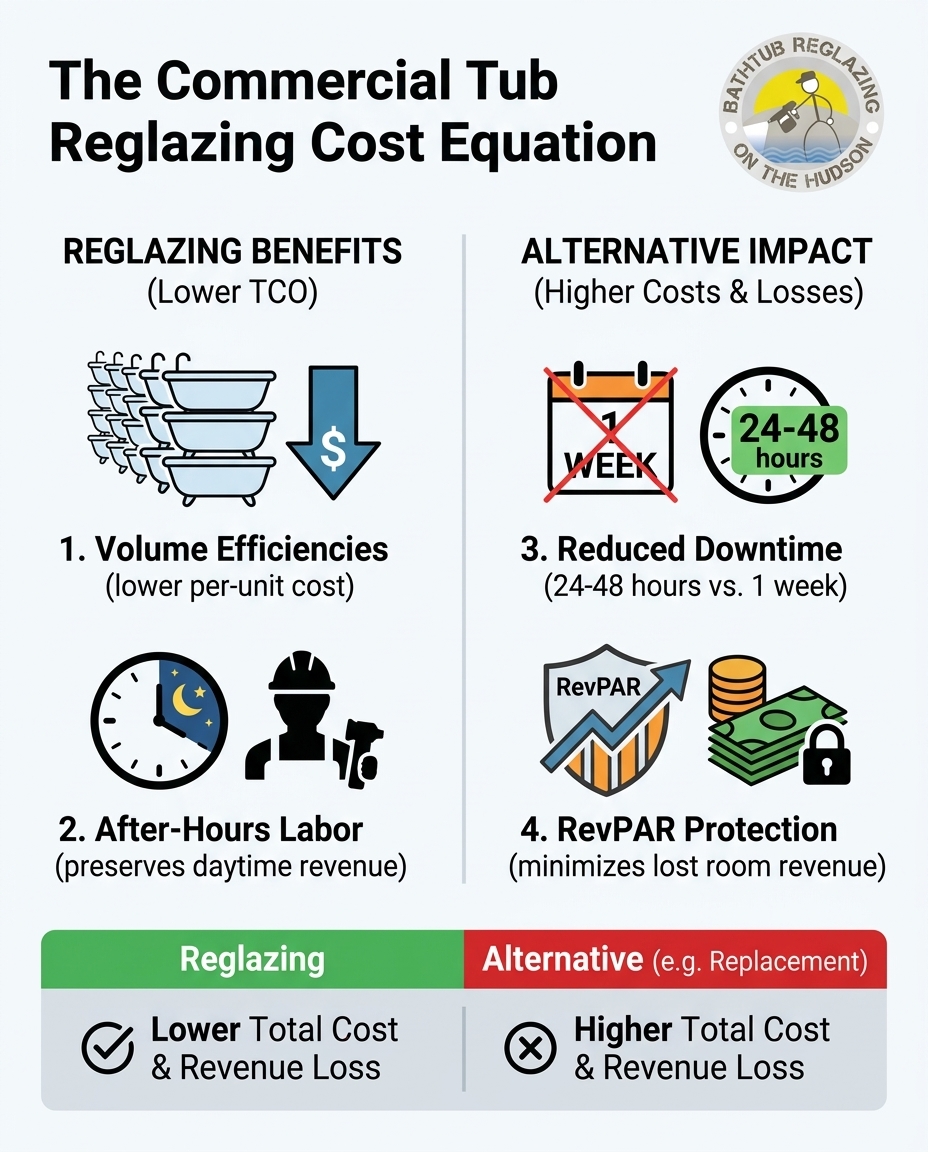
This is where hospitality metrics like RevPAR (Revenue Per Available Room) become critical factors in the renovation cost equation. If a room generates steady nightly revenue, removing it from your available inventory for a week-long demolition project drastically inflates the true cost of that update. The physical replacement might have a set budget, but the lost RevPAR adds a heavy hidden penalty to the project.
Calculating the Impact of Reduced Timelines
Reducing project timelines from weeks down to a tight 24-to-48-hour window drastically shifts the financial ROI in favor of surface restoration. When a unit is prepped, coated, and cured in a fraction of the time it takes to tear out old plumbing and drywall, the room returns to revenue-generating status almost immediately. We always position revenue protection as a primary driver for choosing commercial tub refinishing services over traditional demolition.
• Full Tub Replacement — Average Room Downtime: 5 to 7+ Days — Revenue Impact (RevPAR): High (Extended revenue loss) — Labor Complexity: High (Demolition, plumbing, disposal)
• Professional Reglazing — Average Room Downtime: 24 to 48 Hours — Revenue Impact (RevPAR): Low (Minimal room closure) — Labor Complexity: Low (In-place surface restoration)
How Economies of Scale Influence Multi-Unit Pricing
Another major factor that dictates the average cost to reglaze a tub in a commercial setting is the concept of volume processing. Economies of scale play a massive role in multi-unit pricing. When a facility schedules ten, twenty, or fifty units to be updated simultaneously, the per-unit cost structure changes dramatically. Processing multiple units at once allows our restoration team to operate with maximum efficiency, reducing the overhead associated with single-trip residential jobs.
Mobilizing a crew for a large block of units reduces setup time, limits daily travel requirements, and minimizes material waste. Instead of setting up ventilation, prepping surfaces, and mixing commercial-grade coatings for just one bathroom, technicians can streamline the entire operation across a whole wing or floor of a building.
The Assembly-Line Workflow
The workflow efficiencies gained during volume processing directly influence the final project budget. Technicians can prep, coat, and cure multiple adjacent units in a highly synchronized timeline.
• Phase One: Continuous Prep Work: Technicians move from room to room, handling all the masking, chemical cleaning, and sanding in one continuous sweep.
• Phase Two: Bulk Coating Application: Commercial coatings are mixed in larger, precise batches, and the spray application moves seamlessly down the hall without constant stop-and-start interruptions.
• Phase Three: Synchronized Curing: All units enter the curing phase simultaneously, allowing the entire block of rooms to be returned to the facility manager at the exact same time.
Our crews clarify that these economies of scale are not just about working faster; they are about working smarter. The reduction in redundant labor and material waste is a primary reason why commercial facility budgets look very different from residential quotes.
Minimizing Revenue Loss with After-Hours Scheduling
For facilities that operate around the clock, such as 24/7 fitness centers, active motels, and large healthcare facilities, daytime bathroom closures are simply not an option. Closing a main locker room or a block of high-demand rooms during peak hours leads to guest dissatisfaction, membership complaints, and direct revenue loss. Addressing the unique challenge of updating bathrooms in these environments requires strategic, flexible scheduling.
The upfront investment in after-hours labor rates is almost always offset by the preservation of daytime operational revenue. While scheduling a crew to work overnight may carry a different labor structure than standard daytime hours, the math heavily favors the facility. Paying for off-hours labor is significantly more cost-effective than issuing refunds to angry gym members or comping rooms for frustrated hotel guests.
Protecting 24/7 Facility Operations
The logistics of overnight prep and coating require precision. Technicians arrive after the facility's lowest traffic point, isolate the work area with commercial ventilation, and complete the application process before the morning rush begins. This ensures that the units are actively curing during the hours when the building is quietest.
By emphasizing our team's ability to perform after-hours labor and offer volume discounts, local gyms, motels, and multi-family properties can minimize operational downtime and protect their revenue streams. Flexible scheduling is not just a convenience; it is a critical financial tool for commercial property managers looking to maintain their standard of service during renovations.
Climate Control and Curing: Navigating Fall HVAC Adjustments
Environmental control is a frequently overlooked variable that directly impacts project timelines and costs. Commercial-grade coatings require specific temperature and humidity ranges to cure properly—typically between 68 and 72 degrees Fahrenheit. If the environment is too cold or too humid, the curing process slows down, extending the downtime of the unit and delaying its return to service.
This becomes especially relevant during the October pre-winter indoor season prep. During October fall weather in the Hudson Valley, our technicians often notice that adjusting or disabling commercial HVAC systems during renovations can alter temperature and humidity, directly impacting the curing time of commercial-grade coatings. Many facilities transition their systems from cooling to heating during this shoulder season, which can create unpredictable indoor microclimates.
Coordinating HVAC Management
Understanding the correlation between environmental control and the speed at which units can be returned to service is vital for facility managers. If a hotel wing's heating system is turned off during a fall renovation to save energy, the ambient temperature may drop too low for the coatings to bond and cure efficiently.
Providing guidance on coordinating HVAC management with the reglazing crew helps avoid extended downtime. Facility managers should ensure that the designated work zones maintain consistent, optimal temperatures throughout the entire 24-to-48-hour window. For a deeper dive into how environmental factors affect your timeline, reviewing resources on understanding the curing process and downtime can help properties plan their fall maintenance schedules more effectively.
Expanding the Scope: Coordinating Surround Updates with Reglazing
When a commercial bathtub is taken out of service for restoration, it presents the most cost-effective window to address surrounding tile and grout issues. Coordinating related bathroom updates during the same planned downtime maximizes the facility's return on investment. If the room is already masked off, ventilated, and prepped for the tub, expanding the scope to include the walls is a highly efficient operational move.
Bundling these services reduces overall labor redundancy. Instead of closing the room in October for the tub, and then closing it again in February to fix crumbling grout, completing both tasks simultaneously saves the facility from suffering through two separate periods of lost revenue.
Achieving a Comprehensive Surface Update
A comprehensive surface update provides a completely refreshed look for guests without the timeline of a full remodel. Crisp, clean tile walls paired with a freshly restored bathtub elevate the entire perception of the bathroom. Facility managers can leverage bathtub tile surround updates alongside the tub restoration to deliver a pristine, unified aesthetic that meets high hospitality standards, all within the same brief 24-to-48-hour operational window.
Frequently Asked Questions About Commercial Tub Reglazing Costs
For property managers in Peekskill and Hudson Valley commercial properties, understanding the nuances of large-scale restoration is key to accurate budgeting. Here are the most common questions facility managers have regarding multi-unit reglazing variables.
What factors affect the cost of commercial tub reglazing?
The primary factors include the volume of units being processed simultaneously, the current condition of the tubs, and the specific scheduling requirements of the facility. If previous coatings require extensive chemical stripping before new prep can begin, the labor time increases. Additionally, the need for after-hours or weekend labor to accommodate 24/7 operations will shift the labor structure. Volume discounts often offset these variables when large blocks of rooms are processed together.
How does volume pricing work for motel bathtub refinishing?
Volume pricing works by spreading the initial mobilization and setup costs across multiple units rather than applying them to a single bathroom. Technicians can stage prep work, masking, and coating applications in a continuous, assembly-line workflow down a hotel corridor. This bulk approach drastically reduces per-unit labor time and allows for material bulk purchasing, which ultimately lowers the overall project budget for the property.
Does after-hours bathtub reglazing save commercial properties money?
Yes, after-hours scheduling saves money by preventing the loss of daytime operational revenue. This is particularly beneficial for 24/7 facilities like gyms or busy motels where daytime closure would require member compensation, issue refunds, or cause widespread guest dissatisfaction. The premium associated with off-hours labor is generally much lower than the heavy cost of lost daily business and damaged reputation.
Is it cheaper to reglaze or replace multiple hotel bathtubs?
Reglazing is significantly more cost-effective because it avoids heavy demolition, plumbing modifications, and expensive landfill disposal fees. Replacement takes revenue-generating rooms offline for days to weeks, whereas reglazing requires only 24 to 48 hours of downtime. The combination of lower direct service costs and preserved RevPAR (Revenue Per Available Room) makes surface restoration the clear financial choice for commercial upgrades.
How long does commercial tub refinishing take?
Individual units can often be prepped and coated in just a few hours, and multi-unit staging allows for dozens of tubs to be processed in a single shift. Once the application is complete, full curing typically requires 24 to 48 hours under optimal, climate-controlled conditions. Maintaining an indoor temperature of 68 to 72 degrees Fahrenheit ensures the commercial coatings cure efficiently, allowing the facility to return the rooms to service promptly.
Plan Your Commercial Bathroom Upgrades Today
Ultimately, when determining what is the average cost to reglaze a tub in a commercial setting, the answer is found in the balance of volume efficiencies, strategic scheduling, and revenue protection. True commercial pricing is not a flat number; it is a customized framework designed to minimize operational downtime while maximizing the visual impact of your facility's bathrooms.
Having a clear understanding of how economies of scale and off-hours labor mitigate lost revenue gives you the power to evaluate quotes based on your specific operational needs. Do not let aging bathrooms negatively impact your guest experience or your bottom line. Our team at Bathtub Reglazing On The Hudson encourages facility managers to schedule a professional assessment today to determine the exact variables, timelines, and efficiencies available for their unique property.
Schedule Service
Thank you! Your submission has been received!
Oops! Something went wrong while submitting the form.
Other Blogs
Customer Testimonials
Hear what customers are saying about our professional refinishing and outstanding results.

Can’t say enough about Maurice. From start to finish great communication his work is incredible and he stands by it very competitive pricing just all-around good guy the work was done quick and kept very clean and our brand new bathroom
Joey N.
We had a large piece of bathtub glaze chip off. Maurice came in and did a fantastic job. It now looks and works better than before. He went above and beyond the contract by cleaning up the old chipped grout between the tub and the tiles and replacing with brand new.
Bozidar J.
Maurice did a great job on my tub. It looks brand new.
Steven S.