


Beyond the Lowest Estimate: Evaluating What Goes Into a Reglazing Quote
How much does it cost to reglaze a bathtub? That is the exact question homeowners ask the moment they notice peeling paint, deep stains, or rust forming around their drain. When you start decoding the true price of tub reglazing in the Hudson Valley: labor, materials, and prep work are the three variables you must understand. A flat service fee rarely tells the whole story, especially if your home hides underlying moisture damage or botched previous repairs. True value is measured in the hours a technician spends preparing the surface, not just the minutes they spend spraying a final coat.
Ready to restore your fixture the right way? Learn more about our professional bathtub reglazing services today.
In our years of restoring fixtures in Peekskill and across the region, the team at Bathtub Reglazing On The Hudson frequently sees homeowners make the mistake of choosing a contractor based strictly on the lowest raw number. A bottom-tier estimate almost always indicates that the provider is skipping critical, labor-intensive steps. If a quote seems too good to be true, it likely omits the heavy lifting required to ensure the new finish actually adheres to your tub. Without proper preparation, even the best coating will begin to peel, flake, and bubble within a matter of months.
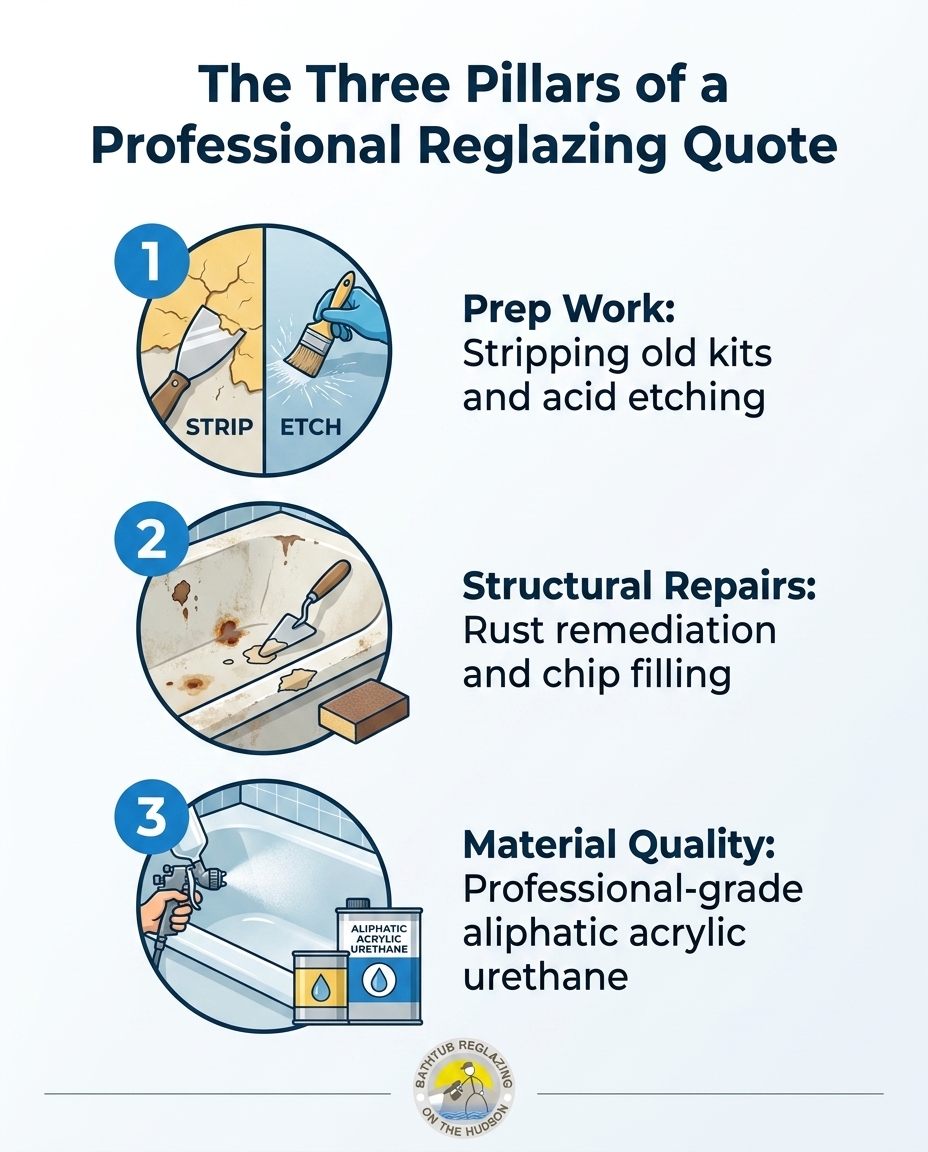
A professional, comprehensive estimate rests on three main pillars: intensive prep work, structural repairs, and high-grade materials. Every bathtub requires a different level of intervention. Older homes frequently hide rust under the overflow plate or moisture damage beneath failing DIY epoxy kits. Addressing these issues takes time, expertise, and specialized equipment.
Our approach emphasizes transparent, detailed pricing that outlines exactly what you are paying for. We believe in educating homeowners on the intensive prep work required to deliver a lasting finish, rather than offering cheap, short-lived fixes that will inevitably need to be redone. Understanding the anatomy of your quote protects your investment and guarantees a beautiful, durable result.
The Foundation of Every Quote: Prep Work and Labor Hours
Surface preparation is undeniably the most labor-intensive portion of any restoration project. It is the invisible foundation that dictates the lifespan of your new finish. When evaluating quotes, the bulk of the labor hours should be dedicated to cleaning, stripping, and etching the tub before a single drop of new coating is applied. This is especially true for older Hudson Valley residential properties, where our team typically sees decades of heavy use, hard water deposits, and previous repair attempts leaving behind a complex surface that requires meticulous attention.
For example, one local homeowner noticed their main bathroom tub had severely discolored after 25 years of direct summer sun exposure. Because the underlying surface was properly stripped and prepped by our technicians, the entire restoration was completed in a single day, leaving an amazing, long-lasting finish. Thorough prep work is what makes that kind of turnaround possible without sacrificing quality. If you are scheduling bathtub reglazing in Orange County, ensuring your technician prioritizes surface preparation is the key to a successful project.
Stripping Previous Coatings
If your tub has been painted or reglazed in the past, that old material must be entirely removed. Removing failed DIY kits or cheap epoxy overlays requires specialized industrial solvents and hours of manual scraping. You cannot simply paint over peeling material and expect the new coat to stick.
• Chemical stripping: Our technicians apply heavy-duty strippers to break down the molecular bonds of the old, failing epoxy.
• Manual removal: Every inch of the tub is scraped by hand by our team to remove stubborn patches of old glaze.
• Labor impact: Addressing botched previous jobs significantly increases the labor hours required for the project, which will be reflected in a professional estimate.
Acid Etching the Surface
Porcelain and fiberglass bathtubs are naturally smooth and non-porous. For a new coating to bond permanently, the surface must be mechanically and chemically altered. Acid etching is a non-negotiable step in professional reglazing.
• Creating microscopic pores: The etching solution we use dulls the original finish, creating thousands of microscopic abrasions.
• Mechanical grip: These tiny pores give the new primer and topcoat something to physically grip onto, ensuring a permanent bond.
• Preventing failure: Skipping the acid wash is a pattern we see often when evaluating why cheap reglazing jobs peel away in sheets almost immediately.
Structural Repairs: Addressing Rust and Chips Before Glazing
Reglazing is not merely a painting service; it is a complete structural restoration. Before any new finish can be applied, the physical integrity of the bathtub must be restored. Pre-existing damage, such as deep gouges, spider cracks, and hidden rust, dictates the overall scope of work. A professional technician evaluates these structural deficits and factors the necessary repairs into your evaluation.
Consider a recent scenario where a customer discovered severe rust forming around their tub's drain, threatening the integrity of the entire fixture. Rather than facing the massive demolition required to tear the unit out, a quick appointment allowed our technicians to perform clean, efficient rust remediation. The tub was fixed and entirely saved from replacement. Whether you need chip repair or full bathtub refinishing in Ulster County, addressing the physical damage first is what makes the final result look factory-new.
Rust Remediation in Cast Iron
Older cast iron tubs are incredibly durable, but they are highly susceptible to rust once the original porcelain wears thin. Rust typically hides around the drain flange and the overflow plate. To ensure a lasting finish, our team follows a strict remediation process:
1. Identification and grinding: We locate all active oxidation and use specialized grinders to take the rust down to bare metal.
2. Chemical neutralization: A professional-grade rust inhibitor is applied to stop the oxidation process at a chemical level.
3. Waterproofing: The area is sealed with a waterproof body filler to prevent moisture from ever reaching the bare iron again.
4. Sanding flush: The repaired area is sanded completely flush with the surrounding tub contour so it disappears under the new glaze.
Filling and Sanding Chips
Dropped shampoo bottles and heavy impacts leave deep chips in the tub floor. These physical divots must be professionally filled and leveled.
1. Cleaning the gouge: Our technicians clean the chipped area of all soap scum and debris.
2. Applying waterproof resin: We pack a specialized waterproof resin into the chip, slightly overfilling the hole.
3. Precision sanding: Once cured, the resin is meticulously sanded down to create a mirror-smooth foundation.
4. Blending the repair: We ensure the repair blends seamlessly into the existing curve of the tub, leaving no visible bumps or ridges.
Material Quality: Professional Coatings vs. DIY Kits
The vast difference in material quality is a major factor in understanding your restoration estimate. Shifting your focus from the raw price to the long-term durability of the materials used will save you immense frustration. Not all coatings are created equal. Lower-tier competitors often rely on vague "paints" or standard epoxies to keep their quotes artificially low. In contrast, Bathtub Reglazing On The Hudson prioritizes extreme transparency by exclusively utilizing high-grade aliphatic acrylic urethane.
Premium materials account for a distinct portion of a professional's estimate, but they deliver a finish that actually withstands daily use. When a large piece of bathtub glaze chipped off for one homeowner, the repair required more than just a quick patch. Our technicians performed a full reglazing with premium materials, cleaned up the old grout, and replaced it, leaving the tub looking and functioning better than before. If you want to understand exactly what you are paying for, reviewing the cost breakdown of DIY vs. professional reglazing reveals why material selection matters.
The Limits of Standard Epoxy
Off-the-shelf DIY kits and cheap contractor materials rely on standard epoxy resins. While epoxy is hard, it is incredibly brittle. Over time, standard epoxy is highly prone to chipping when struck by dropped items. Furthermore, epoxy lacks UV stability and resistance to hot water, meaning it will inevitably discolor and yellow within a year or two. This shorter lifespan necessitates frequent reapplications, making cheap materials far more expensive over the life of the home.
Aliphatic Acrylic Urethane Durability
Professional-grade aliphatic acrylic urethane is the industry standard for long-lasting, high-gloss finishes. Unlike brittle epoxies, urethane retains a slight microscopic flexibility. This flexibility allows the coating to expand and contract with the bathtub as it fills with scalding hot water and cools down, preventing thermal shock fractures. Additionally, aliphatic urethane offers superior gloss retention and is chemically resistant to yellowing, ensuring your tub stays bright white for years.
• Durability & Strength — Standard DIY Epoxy: Hard but brittle; prone to impact chipping. — Aliphatic Acrylic Urethane: Highly durable; resists impacts and scratches.
• Flexibility — Standard DIY Epoxy: Rigid; susceptible to thermal shock cracking. — Aliphatic Acrylic Urethane: Micro-flexible; expands/contracts with hot water.
• Color Stability — Standard DIY Epoxy: High risk of yellowing and fading over time. — Aliphatic Acrylic Urethane: UV stable; retains bright white color permanently.
• Gloss Retention — Standard DIY Epoxy: Dulls quickly with regular cleaning. — Aliphatic Acrylic Urethane: Maintains a factory-like, mirror-smooth sheen.
Climate Control: Managing Curing Times and Ventilation
Local weather conditions play a surprising but critical role in the reglazing process. The chemical curing process of professional coatings is highly sensitive to environmental factors, particularly moisture in the air. As Peekskill families gear up for the back-to-school transition this August, managing late-summer humidity and its effect on curing times is a reality our technicians navigate daily. When humidity levels frequently exceed 70% during the end-of-season cooling period, we must implement specialized climate-control strategies to prevent moisture trapping and ensure a flawless cure.
Managing the bathroom environment requires specific equipment and extra labor. Technicians cannot simply open a window and hope for the best; they must actively control the airflow and humidity levels in the workspace to guarantee the coating bonds correctly to the tub surface.
Humidity's Impact on Adhesion
High humidity alters the chemical cross-linking process of urethane coatings. If there is excessive moisture in the air, microscopic water droplets can become trapped between the tub surface and the new glaze. This trapped moisture compromises the bond, leading to bubbling, blistering, and premature failure of the finish. Managing this moisture requires additional prep time, specialized wiping solvents, and careful monitoring of the room's dew point before spraying begins.
Professional Ventilation Protocols
To combat environmental challenges and manage the strong fumes generated by professional curing agents, our technicians use industrial exhaust systems. These heavy-duty ventilation units pull stagnant, humid air out of the bathroom and vent it safely outside the home. By regulating the bathroom environment, these exhaust systems ensure safe, effective curing regardless of the exterior weather conditions, protecting both the integrity of the finish and the air quality of your home.
The Hidden Costs of Cutting Corners on Reglazing
Choosing a provider based solely on the lowest estimate often leads to a frustrating cycle of premature failure. When contractors cut corners by skipping the acid wash, ignoring hidden rust, or using standard epoxy, the resulting finish will inevitably peel. A pattern we see often is homeowners calling us to fix a peeling tub that was hastily painted over just months prior. The true cost of a cheap job is discovered when you have to pay a professional to fix it.
Repairing a botched job requires stripping the tub entirely down to the original surface again. This multiplies the labor hours required, making the second restoration far more intensive than if the job had been done correctly the first time. Furthermore, a sloppy contractor may fail to protect the surrounding bathroom fixtures, leading to overspray on your floors, vanity, or walls. True value comes from a lasting, flawless finish rather than a quick patch. If your entire bathroom needs an update, comprehensive prep is just as vital for bathroom tile reglazing as it is for the tub itself.
Frequently Asked Questions About Reglazing Factors
Why do bathtub refinishing quotes vary so much?
Variations are largely due to the thoroughness of the prep work included in the estimate. Lower quotes often skip essential, labor-intensive steps like acid etching, rust remediation, or stripping old paint. They may also rely on inferior epoxy materials that fail quickly. A higher, professional estimate reflects the necessary hours spent ensuring the new finish will permanently bond to the tub.
Does rust repair increase the scope of tub refinishing?
Yes, rust must be completely remediated and sealed before any glazing can occur. If a technician ignores active rust, it guarantees the oxidation will bleed right through the new finish, ruining the entire project in a matter of weeks. Properly grinding down the rust, applying neutralizers, and sealing the area requires additional labor and materials, which expands the scope of the job.
How long does professional tub reglazing take?
A proper, professional job typically takes a full day to complete. The vast majority of those hours are dedicated solely to surface preparation, stripping, etching, and structural repairs. Once the topcoat is applied, specific curing times add to the timeline before the tub can be safely exposed to water or daily use.
Is it worth it to reglaze an old cast iron tub?
Absolutely. Cast iron tubs are incredibly durable, structurally sound, and retain bathwater heat exceptionally well compared to modern acrylic tubs. Reglazing restores their original, glossy beauty and smooth texture without the massive demolition, plumbing alterations, and landfill waste required to physically remove them from an older home.
How does humidity affect bathtub reglazing?
High humidity can severely interfere with the chemical curing agents used in professional coatings. Excess moisture in the air can become trapped under the glaze, leading to bubbling and poor adhesion. To combat this, technicians must use specialized industrial ventilation and climate control protocols to ensure a smooth, durable finish regardless of the weather outside.
Schedule an Inspection for Your Reglazing Project Today
Understanding the variables behind a professional quote empowers you to make the best decision for your home. By prioritizing intensive prep work, thorough structural repairs, and premium materials, you guarantee a beautiful restoration that will withstand years of daily use. Don't settle for a quick fix that cuts corners on the steps that matter most.
Are you ready for a transparent evaluation of your fixture? Reach out today to schedule an inspection and get a detailed breakdown of the labor and materials needed to give your bathtub a flawless, lasting finish.
Schedule Service
Thank you! Your submission has been received!
Oops! Something went wrong while submitting the form.
Other Blogs
Customer Testimonials
Hear what customers are saying about our professional refinishing and outstanding results.

Can’t say enough about Maurice. From start to finish great communication his work is incredible and he stands by it very competitive pricing just all-around good guy the work was done quick and kept very clean and our brand new bathroom
Joey N.
We had a large piece of bathtub glaze chip off. Maurice came in and did a fantastic job. It now looks and works better than before. He went above and beyond the contract by cleaning up the old chipped grout between the tub and the tiles and replacing with brand new.
Bozidar J.
Maurice did a great job on my tub. It looks brand new.
Steven S.