

Trading Summer Humidity for Crisp Autumn Curing Conditions
The heavy, sticky air of summer is finally breaking across the region, which is exactly why October's lower dew points make for ideal tub reglazing conditions. For months, your home has been fighting against the ambient moisture that rolls up the river valley. Here at Bathtub Reglazing On The Hudson, our team knows firsthand that while that humidity is uncomfortable for you, it is actively hostile to home improvement projects that rely on precise chemical reactions. When we see homeowners attempt bathroom restorations during the peak of summer, excess moisture in the air often leads to extended tackiness, poor adhesion, or a compromised finish on fresh coatings.
If you are ready to upgrade your bathroom, exploring professional reglazing services ensures a durable finish, and scheduling your bathtub reglazing now takes full advantage of the season.
October provides a highly stable, dry atmospheric window that eliminates these moisture-related risks entirely. Understanding this seasonal shift helps you time your renovations for the most durable, glass-like finish possible.
• The summer struggle: High ambient moisture slows down the evaporation of solvents, leaving surfaces vulnerable to dust.
• The autumn advantage: Lower atmospheric dew points mean the air is physically capable of holding less water, creating a naturally dry environment indoors.
• The long-term benefit: A coating applied in optimal weather cures harder, resists chipping better, and lasts significantly longer.
By trading the unpredictable summer humidity for crisp autumn weather, you set the stage for a flawless restoration that will easily withstand the daily wear and tear of a busy household.
The Chemistry of Urethane Coatings and Atmospheric Moisture
To understand why the weather outside matters for a project inside your bathroom, you have to look at how professional coatings actually work. High-quality tub restoration does not use traditional house paint. Instead, it relies on advanced urethane coatings that undergo a complex chemical process to harden into a durable shell.
How Cross-Linking Works
Professional tub coatings rely on a chemical cross-linking process, not just evaporation. When the two components of a professional urethane are mixed, they begin to bind together at a molecular level. This creates a dense, non-porous surface that mimics the look and feel of original factory porcelain. However, this chemical reaction is highly sensitive to its environment. It requires a specific 24 to 48-hour window of stable ambient conditions to harden completely.
The 48-Hour Critical Window
During the first two days after application, the coating is actively curing. If the air inside your bathroom is too wet, water molecules interfere with the chemical bonds forming in the urethane. The moisture reacts with the hardening agents, weakening the final structural integrity of the glaze. This is why attempting this process in mid-July often yields inferior results compared to scheduling it in mid-fall or October.
A controlled environment ensures the urethane cures to its maximum intended hardness. When the air is dry and stable, the cross-linking process proceeds without interruption. The solvents evaporate at the correct rate, the polymers bind tightly, and the resulting surface is incredibly resilient against hot water, soap scum, and daily use.
Dew Point vs. Relative Humidity: The Metric That Actually Matters
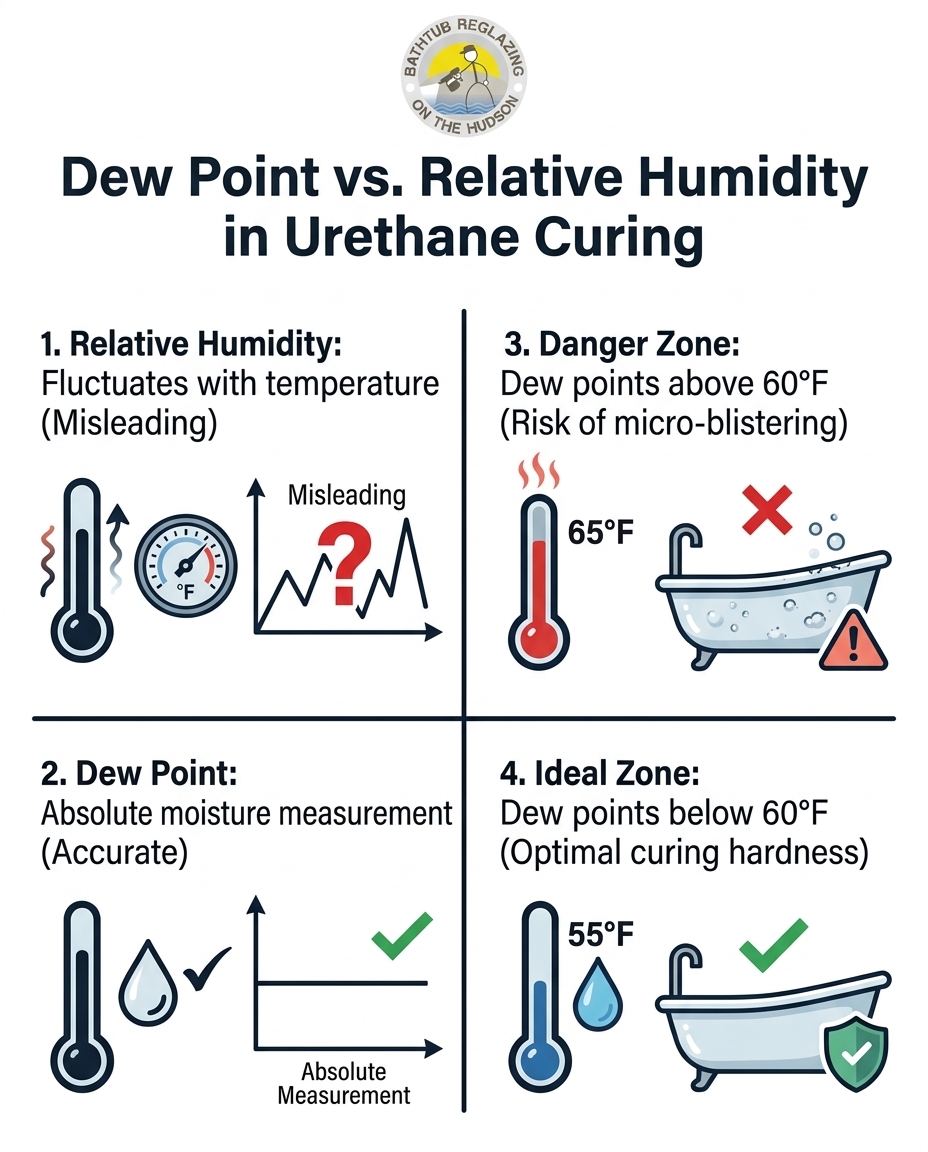
When most homeowners check the weather, they look at relative humidity. However, relative humidity is a percentage that changes with the air temperature, making it a highly misleading metric for indoor curing environments. To get a true read on the moisture in your home, you have to look at the dew point.
Dew point measures the absolute amount of moisture in the air. It is the exact temperature at which water vapor condenses into liquid water. If you want to dive deeper into how these metrics shift as the seasons change, you can read more about how fall humidity fluctuations affect tub curing.
Ideal curing conditions for urethane demand lower atmospheric dew points, specifically below 60 degrees Fahrenheit.
• Relative Humidity (RH) — What It Measures: The percentage of moisture the air holds at a specific temperature. — Impact on Tub Coatings: Misleading. 50% RH at 85°F holds far more water than 50% RH at 65°F.
• Dew Point — What It Measures: The absolute temperature where invisible vapor turns into liquid condensation. — Impact on Tub Coatings: Accurate. A dew point below 60°F guarantees the tub surface remains dry.
When dew points drop in the fall, the risk of invisible moisture settling on the tub surface plummets. Porcelain and cast iron tubs naturally stay cooler than the surrounding air. If the dew point is high, microscopic condensation forms on the cool tub surface just before the coating is applied. By waiting for the crisp autumn air, you ensure the tub surface is bone-dry, allowing the urethane to bond perfectly.
The Hidden Dangers of High Moisture: Solvent Entrapment and Micro-Blistering
Applying a fresh glaze when the air is thick with moisture is a recipe for premature failure. The problems that arise from poor atmospheric conditions are rarely visible on day one, but our technicians frequently see them quickly degrade the quality of a bathtub over the following weeks and months.
The Anatomy of a Micro-Blister
High dew points can cause a phenomenon known as solvent entrapment. When the air is humid, the very top microscopic layer of the urethane coating cures faster than the bottom layer. This creates a skin over the wet glaze beneath it, trapping evaporating solvents and chemical gases inside. As these trapped gases expand, they force their way upward, creating tiny bubbles across the surface known as micro-blistering.
Once a surface is compromised by micro-blisters, the protective barrier is broken. Water from your daily showers seeps into these tiny pinholes, reaching the original surface below. This trapped moisture accelerates wear and can cause severe secondary damage. Our team recently helped a local Peekskill homeowner who faced a similar situation during the winter when their bathtub developed significant rust spots after a previous, poorly timed coating failed. By carefully stripping the compromised layers and properly fixing the rust, we saved the tub from a costly replacement and restored it to pristine shape.
Tackiness and Dust Contamination
Beyond bubbling, excess moisture can also cause the finish to remain tacky for days. A tacky surface acts like a magnet, attracting dust, lint, and airborne debris. Instead of a smooth, glossy finish, you are left with a rough, textured surface that is difficult to clean. Meticulous preparation and waiting for lower atmospheric dew points prevent these bubbling and texture issues entirely, ensuring the glaze cures into a hard, impenetrable shell.
Why the Hudson Valley Microclimate Shines in Mid-Autumn
The weather in our region plays a massive role in the success of interior home renovations. During the summer months, coastal air masses push sticky, humid air deep into the region. The river valley acts as a channel, pulling that heavy maritime air northward and elevating indoor dew points well into the danger zone for chemical curing.
However, the local climate shifts dramatically as the seasons change. By mid-autumn, crisp, dry continental air masses sweep down from the north. This weather pattern naturally pushes out the residual summer moisture. The rapid drop in dew points as crisp, dry autumn air replaces the humid coastal summer air is specific to the region, and it creates a perfect window for precise chemical work.
• Summer coastal patterns: High humidity, elevated dew points, and sluggish chemical curing times.
• Autumn continental patterns: Dry air, stable temperatures, and rapid, even cross-linking for urethane.
• Indoor stability: Homes naturally maintain the perfect indoor climate for urethane applications during this transition period.
This seasonal transition provides a reliable, multi-week window of optimal atmospheric stability. Leveraging our deep local expertise in how these specific Hudson Valley weather patterns dictate the chemical curing process allows Bathtub Reglazing On The Hudson to deliver a finish that boasts superior longevity. Whether you are updating a primary bathroom or scheduling tile surround reglazing, taking advantage of the weather in Peekskill and the greater Hudson Valley ensures your surfaces are restored under the absolute best conditions possible.
Maximizing Coating Hardness Before Winter Heating Season
You might wonder why you shouldn't just wait for the dead of winter to tackle this project, since winter air is famously dry. While it is true that January air lacks humidity, the deep winter introduces an entirely different set of environmental challenges that can compromise a fresh glaze.
Waiting too long to address a failing surface can leave you dealing with a deteriorating bathroom all year. One of our customers reached out last summer because their tub was in extremely rough shape, making the entire bathroom feel dated. While our team successfully restored the tub to look good as new, battling the summer humidity required extra climate-control steps. By scheduling your project in mid-fall, you get that same pristine result without the added environmental hurdles.
While winter air is dry, indoor heating systems can aggressively dry out the air inside your home. Furnaces and boilers create intense convective currents that circulate excessive amounts of dust and pet dander. If this dust lands on a freshly applied coating before it cures, it ruins the smooth finish.
Winter also makes it incredibly difficult to properly ventilate a bathroom. Professional coatings require airflow to vent chemical odors safely. Opening a window in January drops the ambient temperature of the room below the minimum curing thresholds, halting the chemical cross-linking process in its tracks.
• Summer — Dew Point: High (Risk of blistering) — Ventilation: Easy to open windows — Dust Risk: Low indoor circulation
• Winter — Dew Point: Very Low (Safe) — Ventilation: Freezing (Halts curing) — Dust Risk: High (Furnace circulation)
• Mid-Fall — Dew Point: Low (Optimal) — Ventilation: Mild (Comfortable venting) — Dust Risk: Low (Heating systems off)
Mid-fall / October offers the perfect balance: low dew points without the need for heavy, dust-circulating indoor heating. Taking advantage of this window—and perhaps pairing this with sink refinishing—ensures a flawless, smooth sheen that can withstand daily wear and tear for years to come.
Preparing Your Bathroom for an Autumn Reglaze
Once you have decided to take advantage of the crisp mid-fall / October weather, setting up your bathroom for success is straightforward. Proper preparation ensures that the environment remains as controlled and clean as possible during the critical 48-hour window.
Here is what you need to do to prepare your space:
• Check your ventilation: Ensure bathroom exhaust fans are clean and functional to assist with mild ventilation during and after the application.
• Clear the space: Remove all personal items, shower curtains, bath mats, and toiletries to keep the area completely dust-free.
• Monitor the windows: Keep windows closed if it is raining outside to prevent sudden spikes in indoor humidity.
• Plan for downtime: Plan for the bathroom to be completely off-limits for the full 24 to 48-hour curing period. No running water, no showers, and no foot traffic.
• Secure pets: Keep cats and dogs out of the bathroom to prevent pet hair from settling onto the wet glaze.
By following these simple steps, you help maintain the ideal atmospheric conditions that autumn naturally provides, ensuring the urethane cures into a brilliant, hard shell.
Frequently Asked Questions About Seasonal Tub Maintenance
Does humidity affect bathtub reglazing?
Yes, excessive moisture in the air can severely interfere with the chemical cross-linking of urethane coatings. When the air is too wet, water molecules disrupt the bonds forming within the glaze. This interference can lead to extended curing times, persistent tackiness, or micro-blistering beneath the surface. For the best results, the air needs to be as dry as possible during application.
What is the best time of year to refinish a bathtub?
Mid-fall is ideal due to the combination of mild temperatures and significantly lower atmospheric dew points. This season provides a highly stable environment for chemical curing. It allows you to avoid the extreme humidity and blistering risks of summer, as well as the freezing ventilation challenges and dust circulation of deep winter.
How long does tub reglazing take to cure?
Professional urethane coatings typically require 24 to 48 hours to cure completely. During this time, the polymers are actively cross-linking to form a hard, durable shell. Optimal ambient conditions—specifically low moisture and stable room temperatures—help ensure this timeline is met without unexpected delays or lingering odors.
What happens if a reglazed tub gets wet too soon?
Introducing water before the cure is complete can permanently damage the fresh finish. Water interrupts the chemical hardening process, preventing the glaze from bonding properly to the original surface underneath. This early exposure can cause bubbling, peeling, and a complete breakdown of the coating's structural integrity, often requiring the entire process to be redone.
What is the difference between relative humidity and dew point for curing?
Relative humidity fluctuates with the air temperature, while the dew point measures the absolute amount of moisture present in the air. Because relative humidity can be misleading depending on how warm the room is, professionals rely on the dew point to gauge safety. A dew point below 60°F is the true metric for safe, reliable urethane curing.
Secure Your October Reglazing Window
Understanding exactly why October's weather creates the perfect curing conditions gives you the confidence to lock in your maintenance timeline. You do not have to guess if the weather will cooperate; the crisp, dry air of autumn naturally provides the exact environment professional urethane coatings need to thrive. Taking advantage of lower dew points ensures a durable, beautiful finish that will resist chipping and peeling for years.
If your bathroom is looking tired, worn, or dated, now is the time to act. Explore professional options to revitalize your bathroom before the busy holiday and winter seasons begin. By scheduling your project now with Bathtub Reglazing On The Hudson, you guarantee a flawless result that will make your space feel brand new.
Schedule Service
Thank you! Your submission has been received!
Oops! Something went wrong while submitting the form.
Other Blogs
Customer Testimonials
Hear what customers are saying about our professional refinishing and outstanding results.

Can’t say enough about Maurice. From start to finish great communication his work is incredible and he stands by it very competitive pricing just all-around good guy the work was done quick and kept very clean and our brand new bathroom
Joey N.
We had a large piece of bathtub glaze chip off. Maurice came in and did a fantastic job. It now looks and works better than before. He went above and beyond the contract by cleaning up the old chipped grout between the tub and the tiles and replacing with brand new.
Bozidar J.
Maurice did a great job on my tub. It looks brand new.
Steven S.