

Myth: All Bathtub Fillers Perform the Same Under the Glaze
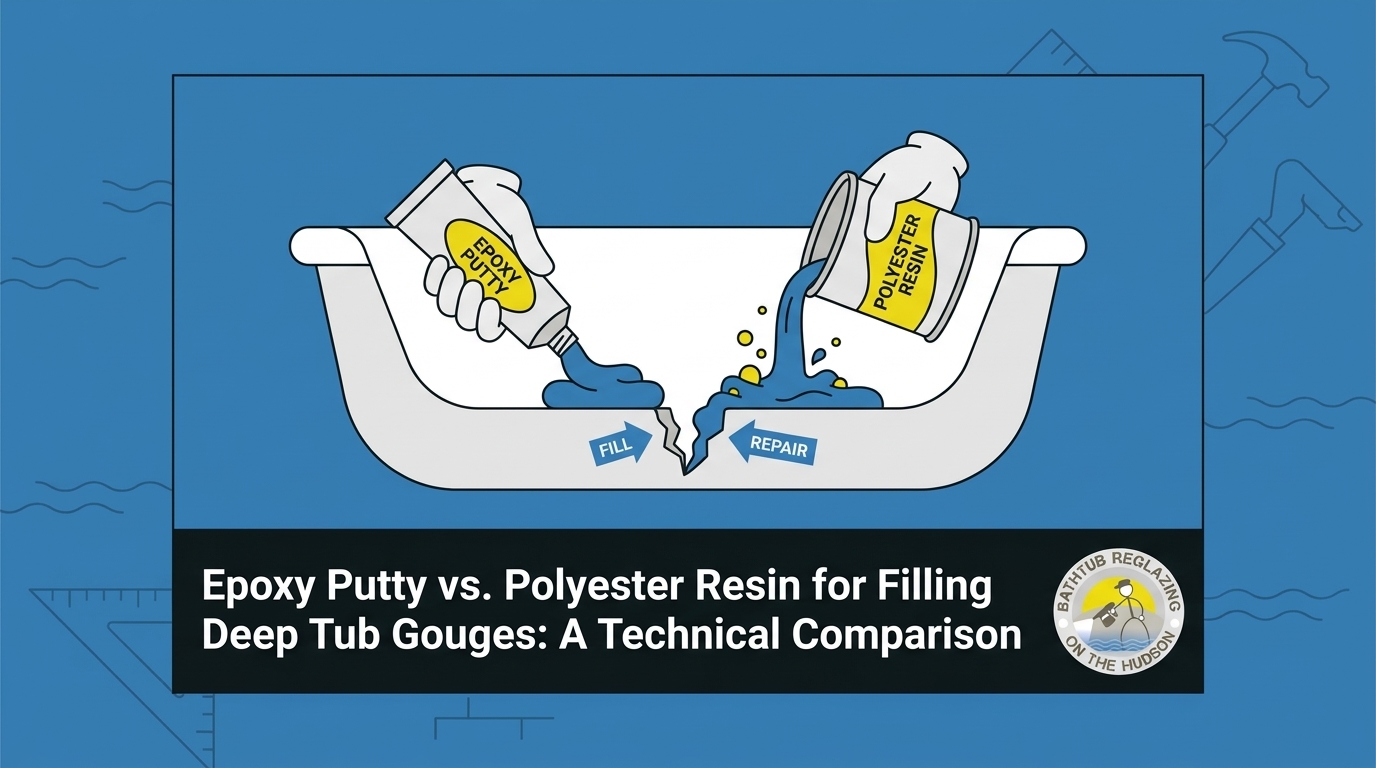
A common misconception among homeowners is that any standard filler, automotive body putty, or hardware store patch kit is perfectly fine for fixing a damaged bathtub. The reality is far more complex. When deciding between epoxy putty vs. polyester resin for filling deep tub gouges, your choice determines whether your repair will last for decades or fail in a matter of months. A universal filler simply does not exist when it comes to structural bathtub repair.
The core problem arises when trying to repair deep structural gouges in older tubs before applying the final topcoat. The underlying tub material, the physical depth of the damage, and the ambient room temperature all dictate how a patching compound behaves. This is especially true as we head into October and mid-fall, when dropping temperatures completely change how these compounds cure and harden. Choosing the wrong material leads to sub-surface failure, which eventually ruins the visible finish.
For those seeking professional tub reglazing, understanding the hidden chemistry beneath the surface is just as vital as admiring the final glossy coat. That is why top-tier bathtub reglaze services never rely on a one-size-fits-all patch, but instead analyze the specific environmental and structural needs of your bathroom before mixing a single ounce of filler.
The Sub-Surface Stakes: Why Your Choice of Filler Matters
To understand why filler selection is so important, you have to look past the shiny topcoat and examine the foundation of the repair. A superficial surface scratch might only require a light smoothing, but a "deep gouge" penetrates completely through the original factory glaze, exposing the raw substrate beneath. In historic homes throughout Peekskill NY, where heavy cast iron and older fiberglass tubs are common, exposing this raw material introduces significant structural challenges.
One local homeowner experienced this firsthand during a fall renovation. They had a problem with some bubbling after previous painters failed at a difficult job using an incorrect, high-shrinkage filler. A professional technician came back, removed the compromised layer, fixed the bubbling issue with the correct structural compound, and stood by the work to ensure a permanent bond. A flawless bathtub refinishing job relies entirely on the structural integrity of this hidden filler layer.
The Mechanics of Material Adhesion
Chemical vs. Mechanical Bonding: Fillers do not just sit inside a hole; they must grip the edges of the damage. Mechanical adhesion happens when a filler locks into the microscopic pores and scratches of the raw tub material. Chemical adhesion occurs when the resin physically fuses with the surrounding surface. Non-porous surfaces like cast iron require materials with massive shear strength to hold tight, whereas flexible fiberglass tubs need a filler that can bend slightly without snapping.
The Hidden Danger of Shrinkage
The Void Effect: As liquid resins and putties cure into solids, they undergo a chemical reaction that often causes them to contract. If a low-quality filler shrinks even a few millimeters inside a deep gouge, it pulls away from the edges of the tub. This creates a microscopic void beneath your new glaze. Every time you fill the tub with hot water, the tub expands, the topcoat flexes over that empty void, and eventually, the glaze cracks, bubbles, or peels away entirely.
Epoxy Putty: Maximum Adhesion and Minimal Shrinkage
When dealing with severe damage, two-part epoxy putty is often the gold standard for structural repair. Originally developed for demanding marine and plumbing applications, high-grade epoxy consists of a resin and a hardener that, when kneaded together, create an incredibly dense, rigid polymer.
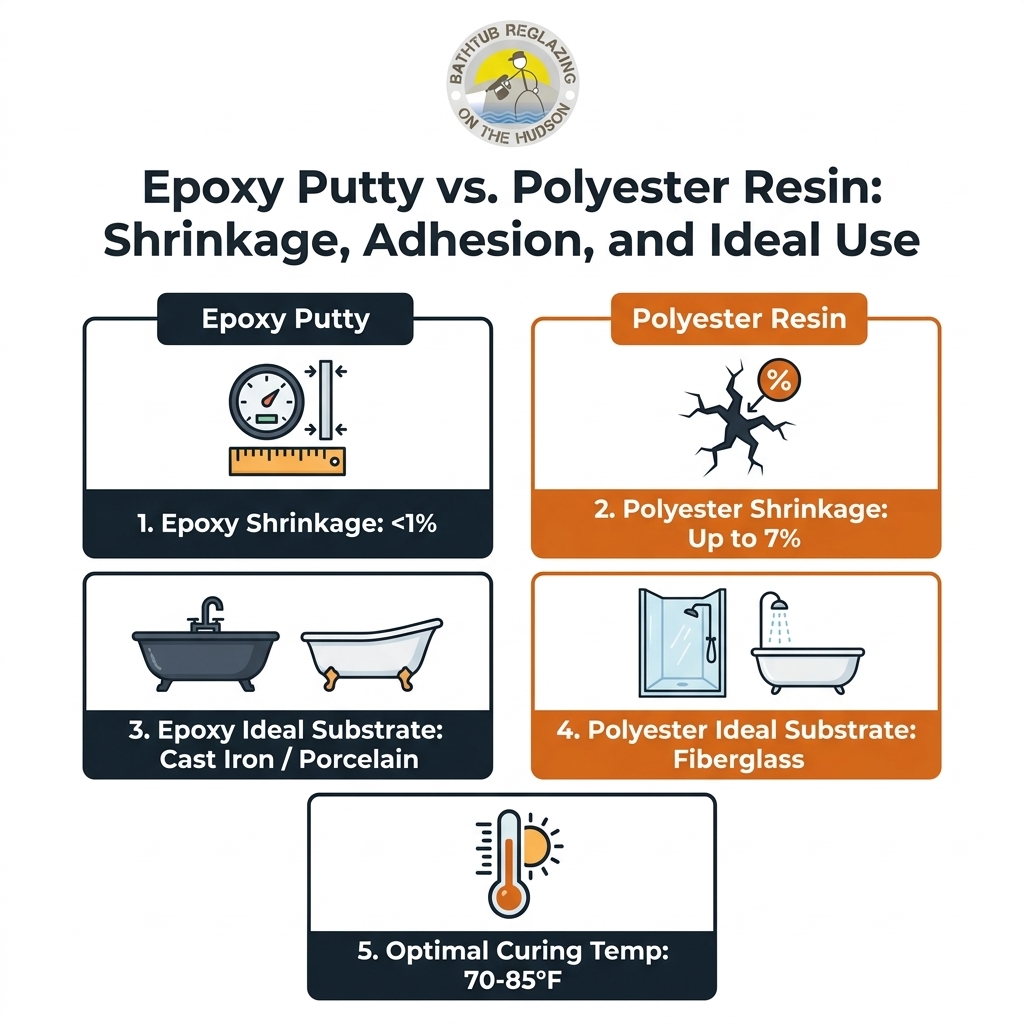
The primary benefit of epoxy putty is its dimensional stability. It boasts a shrinkage rate of less than 1% during the curing process. This means whatever shape you mold it into is the exact shape it stays, completely eliminating the risk of sub-surface voids forming under your topcoat. Epoxy naturally has a longer cure time, and this is further extended by the cooler autumn air typical of October and mid-fall, but the resulting bond is nearly indestructible.
• Superior shear strength: Epoxy resists sliding forces, making it incredibly difficult to dislodge once cured.
• Zero-shrink reliability: With under 1% volume loss, it is safe for filling massive, deep voids in a single application.
• Non-porous bonding: It grips fiercely to dense, unforgiving materials like raw cast iron and porcelain.
• Sanding difficulty: Because it cures harder than the tub itself, it requires significant professional effort to sand perfectly flush.
Ideal Applications for Epoxy
Heavy Cast Iron Tubs: Because cast iron is rigid and heavy, it demands a patching material that matches its structural density. Epoxy putty is optimal for deep structural repairs on these older fixtures where zero shrinkage is absolutely non-negotiable.
Polyester Resin: Fast Curing for Specific Substrates
Polyester resin operates on a different chemical principle. Instead of a simple two-part mix, it relies on a catalytic curing process. When a specific catalyst is introduced to the liquid resin, it triggers a rapid, heat-generating (exothermic) reaction that hardens the material very quickly. This makes it a highly efficient choice for specific types of tub damage.
The major drawback of polyester resin is its contraction rate. As the heat escapes during the curing process, polyester can shrink by up to 7%. If poured thickly into a deep gouge on a rigid cast iron tub, that shrinkage will cause the patch to pull away from the edges. However, many of the mid-century developments in Peekskill NY feature classic fiberglass tub styles where polyester resin's unique properties are actually an asset.
• Rapid curing times: Polyester hardens quickly, allowing technicians to keep the restoration process moving efficiently.
• Ease of shaping: It is significantly easier to sand and feather into a smooth, invisible edge compared to rigid epoxy.
• Material compatibility: It bonds exceptionally well with fiberglass, matching the tub's natural slight flex.
• High shrinkage risk: The 7% volume loss makes it dangerous for deep, single-pour structural repairs.
Managing Polyester Shrinkage
The Layering Technique: To mitigate the volume loss, professionals never fill a deep hole with a single pour of polyester. Instead, they apply it in multiple thin layers, allowing each layer to cure and shrink before applying the next. This requires technical precision and explains why polyester shouldn't be used as a quick, single-step solution for deep cast iron gouges.
Side-by-Side Comparison: Epoxy vs. Polyester for Tub Repair
Understanding the technical differences between these two materials makes it clear why professional assessment is so important. Here is how they stack up across key performance metrics when used in bathtub restoration.
• Shrinkage Rate — Epoxy Putty: Less than 1% (Highly stable) — Polyester Resin: Up to 7% (Requires layering)
• Curing Speed — Epoxy Putty: Slow (Extended in cool weather) — Polyester Resin: Fast (Catalytic heat generation)
• Adhesion Strength — Epoxy Putty: Maximum shear strength — Polyester Resin: Moderate, highly flexible
• Ideal Substrate — Epoxy Putty: Cast Iron, Porcelain, Steel — Polyester Resin: Fiberglass, Acrylic
• October / Mid-Fall Impact — Epoxy Putty: Curing slows significantly; requires supplemental heat — Polyester Resin: Cures faster than epoxy, but still requires temp control
How Ambient Temperature Alters Curing Chemistry
Theoretical chemistry is only half the battle; the environment in your bathroom dictates how these materials actually perform in the real world. Standard repair resins and putties require ambient temperatures of 70 to 85 degrees Fahrenheit for optimal cross-linking. When conditions drop below this threshold, the chemical reaction stalls.
Average October temperatures in Peekskill NY range from the mid-40s to the low 60s. When temperatures drop into the 50s and 60s indoors, the chemical curing process slows exponentially. A putty that takes two hours to harden in July might take twelve hours to cure in mid-fall. If a technician applies the final topcoat over a filler that hasn't fully cross-linked due to cold air, the trapped solvents will eventually force their way up, ruining the glaze.
The Exterior Wall Chill Effect
The Substrate Heat Sink: The reality of mid-fall temperature drops in older Hudson Valley homes is that room air temperature isn't always the same as the tub surface temperature. If your cast iron tub sits against an uninsulated exterior wall, the iron acts as a massive heat sink. Even if your bathroom air is a comfortable 72 degrees, the iron tub itself might be 55 degrees. When room-temperature resin touches that cold iron, the curing process halts immediately. Professionals adapt to this by using supplemental infrared heat to warm the physical substrate, ensuring the chemistry works exactly as intended.
Assessing Gouge Depth: When to Use Which Material
The physical dimensions of the damage are the final factor in material selection. Superficial surface chips that only remove the top layer of glaze can often be smoothed and prepped without heavy structural fillers. However, deep structural gouges that expose the dark, raw tub material require serious intervention.
One customer reached out during the fall when a large piece of their bathtub glaze chipped off, exposing the raw substrate beneath. Because the damage was deep, standard surface putty wouldn't hold. The technician applied a fantastic reglazing and replaced old chipped grout with brand new grout, ensuring the tub looks and works better than before. There is often a rush to fix deep gouges in October and mid-fall before winter guests arrive for the holidays, but rushing the process with inappropriate DIY fillers always leads to failure.
When repairing tubs with massive chips, epoxy is mandatory for the high-impact zones (like the floor of the tub) due to its structural rigidity. If a massive chip isn't filled with a high-shear-strength material, the simple act of stepping into the tub can flex the void and crack the repair.
The Professional Difference: Preventing Topcoat Failure
This is why generic DIY kits from the hardware store rarely last. A small box with a single tube of generic filler cannot account for the depth of your gouge, the material of your tub, or the temperature of your bathroom walls. Professional-grade materials are chosen specifically for the depth and substrate, ensuring a structural repair that won't fail or shrink under the final glaze.
This meticulous approach is part of a commitment to providing permanent, high-quality restorations to the Peekskill NY community. The professional process involves precise, hidden prep work before any glaze is ever sprayed. This is the foundation of reliable bathtub restorations.
1. Thorough Decontamination: The gouge and surrounding area are stripped of all soap scum, oils, and previous failed repair attempts.
2. Acid Etching: The raw edges of the chip are etched to open up microscopic pores, ensuring maximum mechanical adhesion for the incoming filler.
3. Temperature Control: The ambient air and the physical tub substrate are measured and brought up to the optimal 70-85 degree range using targeted heat.
4. Compound Selection and Mixing: Based on the tub material and depth, the exact ratio of epoxy or polyester is mixed on-site.
5. Flush Sanding: Once fully cured, the hardened patch is sanded down through multiple grits until it is completely flush with the original contour of the tub.
Frequently Asked Questions About Tub Repair Materials
Is epoxy or polyester resin better for bathtubs?
The better material depends entirely on the substrate of your tub. Epoxy is generally superior for cast iron and porcelain fixtures due to its incredibly low shrinkage and high adhesion strength. Polyester resin is often preferred for fiberglass tubs because it cures quickly and matches the natural flexibility of the fiberglass shell.
Does epoxy putty shrink after curing?
High-quality marine and plumbing epoxies shrink less than 1% during the curing process, making them highly stable. This dimensional stability is exactly why professionals trust them to fill deep, structural gouges without leaving hidden voids that could compromise the final glaze.
Can you use epoxy putty on a cast iron tub?
Yes, epoxy putty is the preferred material for deep gouges in cast iron due to its immense shear strength. Cast iron is heavy, rigid, and unforgiving, so it requires a patching compound that cures just as hard and bonds fiercely to the non-porous metal surface.
Why do bathtub repairs fail under the glaze?
Failure is typically caused by material shrinkage, poor surface prep, or curing issues related to low ambient temperatures. For example, if a repair is done in October or mid-fall without supplemental heat, the cold tub surface can stall the curing process, trapping solvents that eventually bubble up and ruin the topcoat.
Is polyester resin waterproof for tub repairs?
Yes, once it is fully cured, polyester resin is waterproof. However, to ensure long-term water resistance and prevent degradation, the cured resin must be properly sanded, sealed, and protected by a professional-grade reglazing topcoat.
Ensure a Permanent Fix for Your Damaged Tub
A flawless, beautiful bathtub relies entirely on the hidden chemistry of the structural repair beneath it. Whether you are dealing with a heavy cast iron fixture or a mid-century fiberglass model, filling deep gouges requires technical precision, temperature management, and the right combination of epoxy or polyester compounds. Generic patches simply cannot withstand the daily thermal expansion and water exposure of a busy bathroom.
Homeowners in Peekskill NY don't have to settle for temporary fixes that peel away after a few months. By relying on professional methods that prioritize sub-surface integrity, you guarantee a finish that outlasts any DIY quick-fix. If your tub is suffering from deep chips, rust, or structural gouges, reach out for a professional assessment to have the damage repaired with the correct, permanent materials.
Schedule Service
Thank you! Your submission has been received!
Oops! Something went wrong while submitting the form.
Other Blogs
Customer Testimonials
Hear what customers are saying about our professional refinishing and outstanding results.

Can’t say enough about Maurice. From start to finish great communication his work is incredible and he stands by it very competitive pricing just all-around good guy the work was done quick and kept very clean and our brand new bathroom
Joey N.
We had a large piece of bathtub glaze chip off. Maurice came in and did a fantastic job. It now looks and works better than before. He went above and beyond the contract by cleaning up the old chipped grout between the tub and the tiles and replacing with brand new.
Bozidar J.
Maurice did a great job on my tub. It looks brand new.
Steven S.