

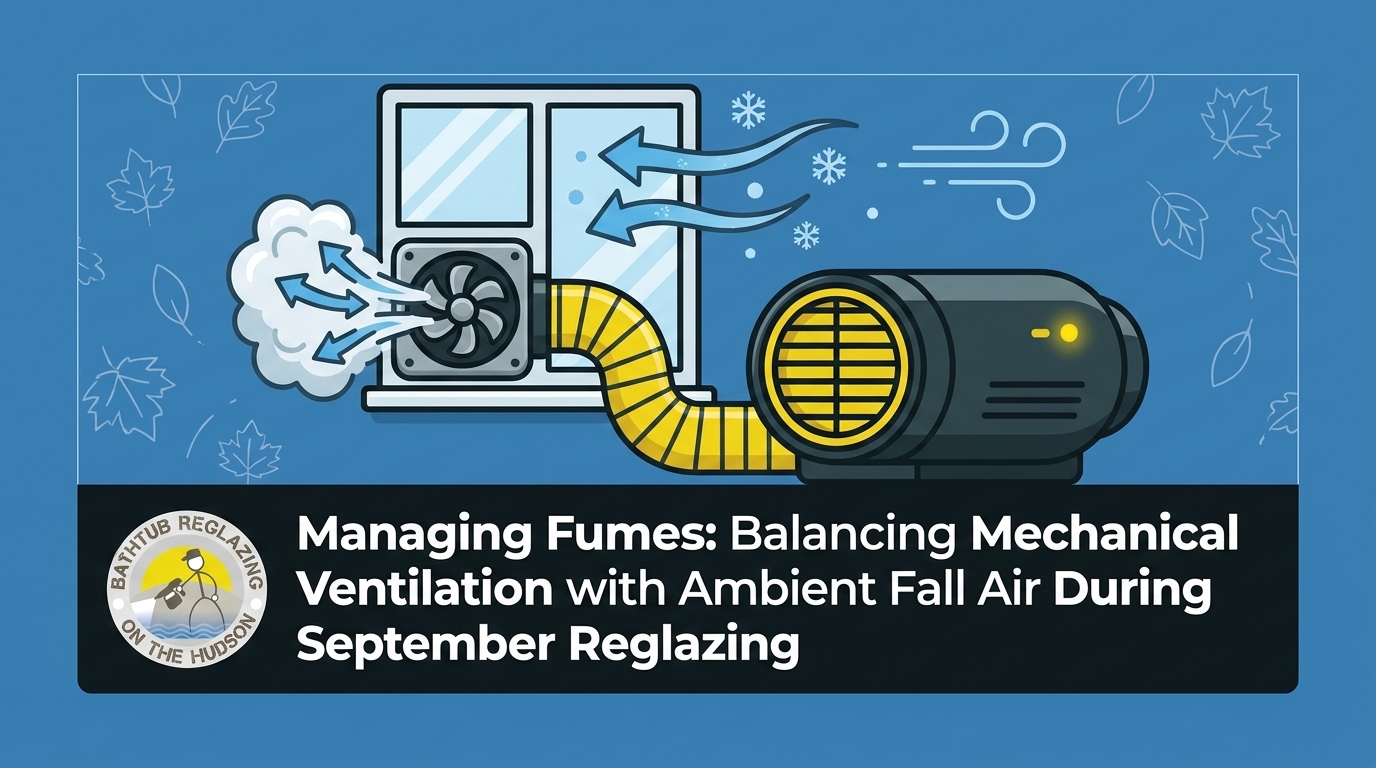
The Seasonal Window for Odor-Free Bathroom Updates
September has arrived in the Hudson Valley, and for homeowners looking to update their bathrooms without the stress of lingering chemical odors, balancing mechanical ventilation with ambient fall air during September reglazing is the ultimate solution. One of the most common anxieties we hear from homeowners is the fear of toxic, overwhelming smells taking over their living space during an indoor home improvement project. It is a valid concern. The industrial coatings required to create a durable, mirror-like finish on a bathtub contain strong solvents, and without a deliberate strategy, those fumes can easily drift into your bedrooms and hallways.
Here is the thing: timing is everything when it comes to indoor air quality management. The transition out of summer creates a unique, highly advantageous opportunity. By leveraging the crisp weather of September early fall in the Hudson Valley, we can expertly balance natural outdoor breezes with high-powered mechanical exhaust systems. This specific seasonal window allows professional reglazing services to minimize disruption and maximize safety in your home.
A proper bathtub reglaze requires absolute precision, not just in how the coating is applied, but in how the environment is controlled. By utilizing targeted airflow and the natural drop in seasonal humidity, we can ensure that fumes are extracted rapidly, leaving you with a beautifully restored fixture and fresh indoor air.
Navigating Fume Extraction in Traditional Architecture
When dealing with older residential buildings, standard ventilation methods almost always fall short. Many Peekskill NY older homes with variable cross-ventilation present unique structural challenges that make fume extraction complicated. Narrow hallways, central staircases that act like chimneys, and small, single-pane bathroom windows can easily trap air in pockets, allowing odors to linger for days if not properly managed.
Most homeowners assume their standard bathroom exhaust fan will handle the job. Unfortunately, these fans simply lack the Cubic Feet per Minute (CFM) capacity to handle industrial coatings. A typical residential bathroom fan pulls about 50 to 80 CFM, which is designed to slowly remove steam after a shower. Reglazing requires moving hundreds of cubic feet of air per minute to safely extract Volatile Organic Compounds (VOCs) before they can settle into the rest of the house.
Furthermore, simply "opening a window" without a directed, mechanical push often makes the problem worse. Depending on the wind direction, an open window can actually blow fumes out of the bathroom and directly into your living room. This requires a deliberate, engineered cross-ventilation strategy to ensure air only moves in one direction: outside.
Understanding these architectural airflow challenges is a crucial step when deciding between bathtub reglazing and replacement. When homeowners realize that professional fume extraction eliminates the odor concerns entirely, the choice to restore their existing fixture becomes much easier and far less disruptive to the household.
• Standard Bathroom Fan — Airflow Capacity (CFM): 50 - 80 CFM — Primary Purpose: Removing light shower steam — Effectiveness on Reglazing Fumes: Poor; allows fumes to drift into the home
• Open Window (No Fan) — Airflow Capacity (CFM): Variable (Wind Dependent) — Primary Purpose: General fresh air — Effectiveness on Reglazing Fumes: Risky; can blow odors back indoors
• DIY Box Fan — Airflow Capacity (CFM): 150 - 300 CFM — Primary Purpose: Cooling a room — Effectiveness on Reglazing Fumes: Moderate; lacks focused directional exhaust
• Professional Mechanical Exhaust — Airflow Capacity (CFM): 800+ CFM — Primary Purpose: Industrial fume extraction — Effectiveness on Reglazing Fumes: Excellent; creates negative pressure zones
The Science Behind Fast Curing and Fume Dissipation
To truly understand why the early fall is the perfect time for this work, we have to look at the chemistry of the curing process and how environmental factors accelerate it. The coatings used in professional refinishing rely on solvents to remain liquid during application. Once the coating hits the tub, those solvents must evaporate rapidly so the resin can harden into a durable shell.
This is where the weather plays a massive role. High summer humidity actively slows down the curing process. When the air is already saturated with moisture, it cannot absorb the evaporating solvents quickly. This traps VOCs indoors for longer periods and forces the coating to cure at a sluggish pace. Conversely, the low-humidity ambient air of September acts like a sponge. The crisp, dry air pulls moisture and fumes out of the coating rapidly, acting as a natural catalyst for the curing process.
Winter presents its own set of problems. While the air is dry, it is often too cold to safely open windows for cross-ventilation without freezing the house or dropping the bathroom temperature below the coating's required curing threshold. The dropping humidity and mild temperatures of Peekskill's specific September climate actively accelerate fume dissipation, creating the ultimate sweet spot between the sticky heat of summer and the bitter cold of winter.
How Solvents React to Atmospheric Moisture
The evaporation phase of reglazing coatings is highly sensitive to the surrounding atmosphere. In professional applications, we measure this in "flash off" times—the exact window it takes for the top layer of the solvent to evaporate into the air. When the ambient humidity is low, the flash-off time is drastically reduced. This means the fumes spend less time in a gaseous state inside your bathroom and are expelled outdoors much faster.
Deploying High-CFM Mechanical Exhaust Systems
Generic claims of "we ventilate the room" are simply not enough when dealing with chemical coatings inside a residential space. The expert methodology behind professional-grade mechanical exhaust systems is what guarantees a safe, low-odor environment. These are not the DIY box fans you buy at a hardware store; these are heavy-duty, high-volume mechanical exhaust units designed specifically for industrial air scrubbing and targeted extraction.
During a recent fall project right here in our service area, a homeowner's bathtub required meticulous prep and a flawless finish. Our technician, Maurice, prepared the surface, created sharp edges, and applied a mirror-smooth finish. The result was a bathtub that looked brand new with a flawless sheen and zero imperfections. A major factor in achieving that perfect, dust-free, glass-like finish was the deployment of a high-CFM exhaust system, which not only removed the fumes but also pulled any airborne dust particles completely out of the room before they could settle into the wet glaze.
Here is how the mechanical exhaust process works to protect Peekskill NY older homes with variable cross-ventilation:
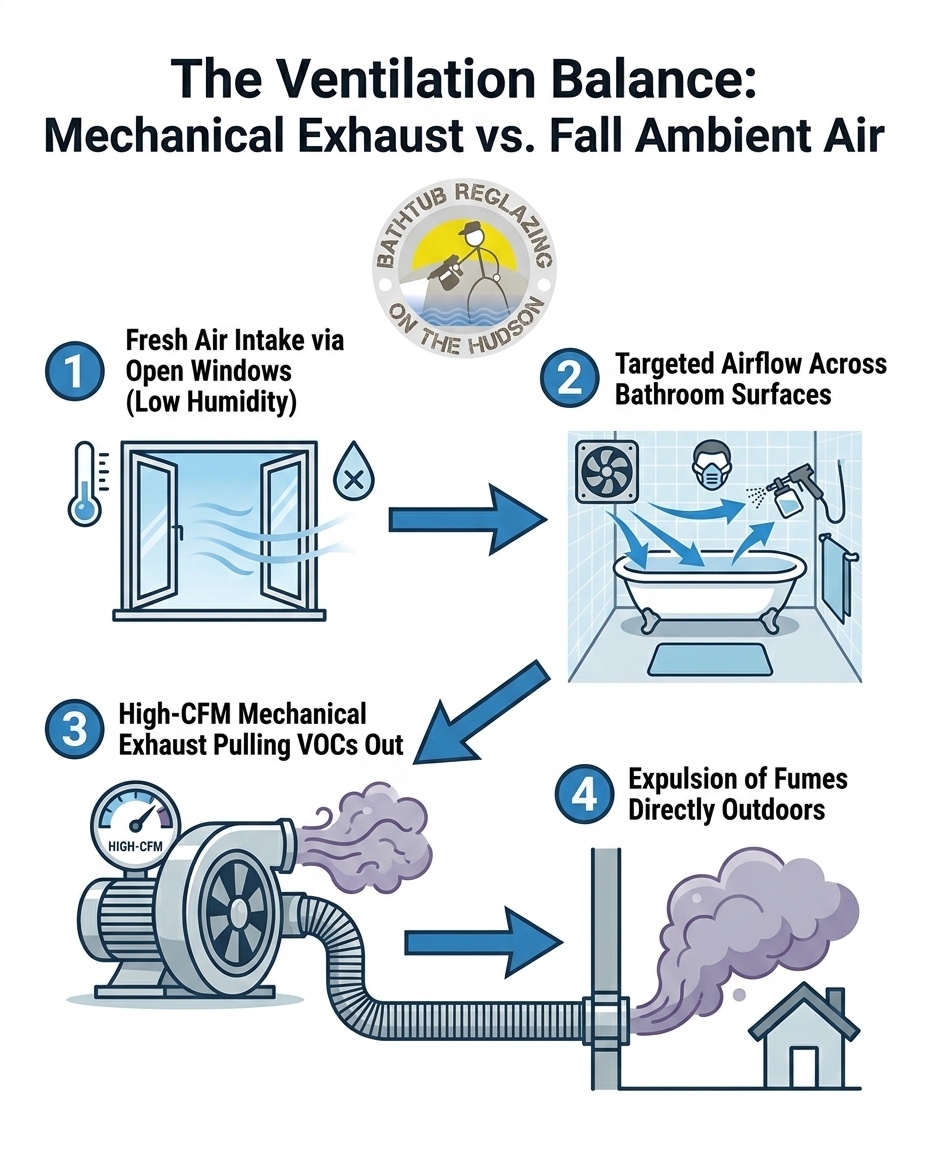
• Establishing Negative Pressure: We seal off the bathroom door and window gaps, forcing the mechanical fan to pull air from the rest of the house into the bathroom, and then directly outside. This ensures fumes can never drift backward into your hallways.
• Maximizing Air Exchanges Per Hour (ACH): A professional system can completely replace the air in a standard bathroom dozens of times per hour. This rapid turnover is critical for safety and odor elimination.
• Targeted Ducting: Heavy-duty flexible ducting is routed from the workspace directly out the nearest appropriate window, ensuring the contaminated air is expelled far away from the home's intake vents.
• Scaling for Larger Projects: When refinishing multiple units in a single building or tackling massive master bathrooms, multiple high-CFM systems are deployed in tandem to maintain that crucial negative pressure zone.
Orchestrating the Perfect Cross-Ventilation Setup
Having the right equipment is only half the battle; knowing exactly how to balance it with the ambient weather is where true expertise shines. Orchestrating the perfect cross-ventilation setup requires a step-by-step methodology to ensure the mechanical systems and ambient air work in perfect harmony.
1. Identifying the Optimal Intake Window: The first step is locating a window in a separate room to act as the fresh air intake. By opening a specific window on the opposite side of the house, we create a clean air tunnel that feeds fresh outdoor air directly toward the bathroom.
2. Positioning the Mechanical Exhaust: The high-CFM fan is positioned to expel fumes directly outside without recirculation. We carefully assess wind direction to ensure the exhausted air isn't blown right back into an adjacent bedroom window.
3. Monitoring Indoor Temperatures: The mild ambient temperatures of the Hudson Valley in early fall allow for windows to be opened for intake without drastically overcooling the home. We monitor the room temperature to ensure the ambient air doesn't drop below the coating's required curing threshold (usually around 68°F to 72°F).
4. Adjusting Airflow Dynamically: As the weather of September early fall in the Hudson Valley shifts throughout the day, breezes can change direction. The setup is monitored and adjusted dynamically to ensure negative pressure is maintained from the start of the prep work until the final flash-off phase is complete.
Expanding the Scope: Managing Airflow for Multi-Surface Projects
Ventilation strategies must scale significantly when additional bathroom surfaces are being restored simultaneously. If you are scheduling a comprehensive bathroom tile reglaze alongside your bathtub, the amount of surface area being coated increases exponentially. A standard bathtub is roughly 30 to 40 square feet of surface area. When you add the surrounding wall tiles, you can easily exceed 150 square feet.
This massive increase in surface area means a compounded release of fumes as the solvents evaporate. To handle this, the negative pressure zones must be expanded to cover the larger square footage effectively. The low-humidity ambient air remains our best asset here, but the mechanical exhaust systems are often run at higher speeds or deployed in pairs to manage the heavier vapor load.
Homeowners can rest assured that professional ventilation easily handles these large-scale projects without leaving lingering odors behind. Strict masking and sealing techniques are utilized to protect adjacent rooms. Heavy-duty plastic barriers and specialized masking tapes are used to seal off doorways, HVAC vents, and electrical outlets, ensuring that the accelerated airflow is completely contained within the active work zone.
Post-Reglazing: When Is the Air Completely Clear?
Setting clear expectations regarding the curing timeline and post-service odor is a vital part of our process. Homeowners often ask exactly when they can close their windows and return to normal life. The short answer is that the vast majority of the heavy fumes are extracted while our technicians are actively working and the mechanical exhaust is running.
Once the primary flash-off phase is complete and the low-humidity ambient air has done its job, the mechanical exhaust is removed. At this point, the air is safe, though you may notice a faint "new car smell" that can linger for 24 to 48 hours. This residual scent is completely harmless and simply indicates the final, slow phase of the resin hardening. During this time, it is usually safe to resume normal HVAC operation in the home, though keeping a bathroom window cracked for an extra day is always beneficial.
Once the surface is fully cured and the air is completely clear, your focus can shift to long-term care. Proper tub cleaning and maintenance will preserve that newly cured, mirror-like surface for years to come, ensuring you never have to worry about a dull or chipping bathtub again.
Frequently Asked Questions About Reglazing Fumes and Ventilation
How do professionals ventilate during bathtub refinishing?
Professionals use high-CFM mechanical exhaust fans combined with targeted ducting to create negative pressure in the bathroom. This setup actively pulls fresh air into the room from the rest of the house and forces the chemical fumes directly outside through a window. By utilizing Peekskill NY older homes with variable cross-ventilation setups correctly, experts ensure odors never drift into your living spaces. This is a massive upgrade over standard bathroom fans, which lack the power to move heavy solvent vapors.
How long do reglazing fumes last in a well-ventilated house?
With professional mechanical exhaust running, the heaviest and most dangerous fumes are removed immediately during the application process. Once the equipment is packed up, you may notice a faint, harmless residual odor—similar to fresh paint or a new car—that typically dissipates entirely within 24 to 48 hours. Keeping the bathroom door closed and a window slightly cracked will speed up the final clearing of the air.
Is it safe to stay in the house after bathtub reglazing?
Yes, it is completely safe to remain in your home after a professional reglazing service is completed. Because the heavy VOCs are actively extracted during the curing's initial flash-off phase, the air quality in the rest of the house remains unaffected. We recommend keeping pets and small children out of the immediate bathroom area for the first 24 hours just to protect the wet finish, but the rest of the home is perfectly safe to occupy.
How do you get rid of bathtub refinishing fumes quickly?
The fastest way to eliminate fumes is by balancing professional exhaust systems with dry, low-humidity outdoor air. If you notice a lingering smell the day after service, simply keep the bathroom window open and leave your standard exhaust fan running to encourage continuous air exchanges. Avoid running hot showers in adjacent bathrooms, as introducing humidity can slow down the final curing and odor dissipation process.
Why is early fall the best time to reglaze a bathtub?
Early fall offers the perfect combination of dropping humidity and mild ambient temperatures. The crisp, dry air acts as a catalyst, pulling moisture and fumes out of the glaze rapidly for a faster cure. Additionally, the mild temperatures allow us to open windows for cross-ventilation without freezing your home, making it the most comfortable and efficient season for indoor chemical applications.
Can I just use my bathroom exhaust fan during reglazing?
No, a standard bathroom exhaust fan is not nearly powerful enough to handle industrial refinishing coatings. Typical residential fans pull between 50 and 80 CFM, which is only sufficient for clearing light shower steam. Relying solely on a bathroom fan will result in heavy fumes backing up into your hallways and bedrooms, which is why professional high-volume exhaust systems are absolutely necessary.
Secure Your September Reglazing Appointment Before Winter
The window of opportunity provided by September early fall in the Hudson Valley is short, but it is undeniably the absolute best time for this specific home improvement. By taking advantage of the crisp, dry air, you ensure the fastest possible curing times and the most efficient odor dissipation. You don't have to choose between a beautiful new bathtub and the comfort of your family's indoor air quality.
Professional equipment guarantees that your home remains safe and odor-free, capturing and expelling fumes before they ever have a chance to settle into your living space. Do not wait until the bitter cold of winter forces your windows shut and eliminates the cross-ventilation advantage entirely. Schedule your inspection or estimate today, and enjoy a clear, logical, and expertly managed process that leaves you with a flawless bathtub and perfectly fresh air.
Schedule Service
Thank you! Your submission has been received!
Oops! Something went wrong while submitting the form.
Other Blogs
Customer Testimonials
Hear what customers are saying about our professional refinishing and outstanding results.

Can’t say enough about Maurice. From start to finish great communication his work is incredible and he stands by it very competitive pricing just all-around good guy the work was done quick and kept very clean and our brand new bathroom
Joey N.
We had a large piece of bathtub glaze chip off. Maurice came in and did a fantastic job. It now looks and works better than before. He went above and beyond the contract by cleaning up the old chipped grout between the tub and the tiles and replacing with brand new.
Bozidar J.
Maurice did a great job on my tub. It looks brand new.
Steven S.