
Preparing for Holiday Guests: The Challenge of Winter Bathroom Updates
As the November pre-winter heating season begins, balancing indoor temperature for winter bathroom renovations becomes a hidden challenge for many homeowners. At Bathtub Reglazing On The Hudson, our team often sees clients rushing to finalize their home updates before the first hard freeze hits the Hudson Valley and holiday guests arrive. The sudden drop in outdoor temperatures prompts the first heavy furnace use of the year, which drastically changes your indoor environment. If you are planning to schedule professional reglazing services, getting a durable bathtub reglaze means coordinating your thermostat just as carefully as you coordinate your calendar.
Most homeowners view a bathroom update as a straightforward scheduling task, but running the furnace constantly alters the indoor climate in ways that directly impact professional renovations. Materials that require specific curing conditions, such as high-grade acrylic urethanes, rely heavily on a stable environment to bond correctly to your existing fixtures. When your heating system cycles on and off, it creates fluctuations in both temperature and humidity that can interfere with this delicate process.
Achieving a flawless finish is a partnership between your home's HVAC system and the professionals performing the work. Understanding how your furnace interacts with the application process allows you to prepare your home properly. By managing your indoor climate proactively, we can ensure that your newly updated bathroom is ready for heavy holiday use without compromising the longevity of the finish.
The Science Behind Curing in Cold Weather
In our years of servicing the Hudson Valley, the most common problem we see homeowners face during late-fall renovations is a fundamental misunderstanding of how professional coatings dry. You might assume that turning up the heat simply makes the paint dry faster. However, the cause of many winter renovation failures is treating a chemical curing process like simple evaporation. Dropping outdoor temperatures force indoor heating systems to compensate, creating a volatile micro-climate that makes it difficult for professional coatings to bond correctly.
The solution requires active environmental management. Professional aliphatic acrylic urethanes typically require an ideal curing temperature between 65°F and 75°F. Achieving this requires deep technical expertise in managing ambient temperature and chemical curing environments. Our professional teams monitor these variables closely to prevent adhesion failure, ensuring that the room remains stable enough for the chemical reaction to complete itself successfully. If you live in an older home in Peekskill NY, maintaining this stability can be particularly challenging due to drafts and rapid heat loss.
Why Chemical Curing Requires Stability
There is a massive difference between evaporation, which is how standard house paint dries, and cross-linking, which is how professional glazes cure. Evaporation simply involves water or solvents leaving the material and entering the air. Cross-linking is a complex chemical reaction where molecular chains bond together to form a hardened, impermeable shell.
Temperature fluctuations actively disrupt the cross-linking process. If the room gets too cold, the chemical reaction slows down or stops entirely, leaving the surface vulnerable. If the room gets too hot too quickly, the top layer of the coating hardens before the bottom layers have a chance to bond to the tub. Stability is the only way to ensure the entire thickness of the coating cures evenly.
Why Your HVAC System is the Biggest Variable in Reglazing
During the November pre-winter heating season, your furnace becomes the most unpredictable variable in your renovation project. Heating cold outdoor air indoors can drop the relative humidity in your home to below 20%. Cold air simply cannot hold as much moisture as warm air. When your furnace pulls in cold air from outside and heats it up, the air expands, but no moisture is added. The result is bone-dry air circulating through your bathroom.
This extreme dryness alters coating adhesion and accelerates flash times. The dry air pulls solvents out of the coating too aggressively. This creates a frustrating tug-of-war: you need to keep the house warm enough to cure the coating, but running the furnace constantly makes the air far too dry. Furthermore, sudden blasts of dry heat can introduce thermal shock to sensitive materials when environments shift rapidly. To understand exactly how these rapid temperature shifts put your fixtures at risk, you can learn more about how freezing temperatures affect curing enamel.
The Impact of Low Humidity on Flash Times
In professional coatings, the flash time is the window between applying the material and the moment the surface begins to skin over. Proper flash times allow the solvents to escape at a controlled rate, ensuring the material remains workable and bonds deeply to the prepared surface.
Bone-dry air causes the surface to skin over before the underlying layers have properly bonded. When the top layer hardens too fast, the trapped solvents underneath have nowhere to go. This leads to solvent popping, bubbling, and a weakened finish that is highly susceptible to peeling once you start using the fixture regularly.
Ambient Air vs. Surface Temperature: A Critical Distinction
One pattern we see often during our winter appointments across Peekskill is homeowners assuming that a warm room automatically equals a warm bathtub. This is a critical distinction to make. Cast iron, steel, and even heavy fiberglass tubs retain cold much longer than the surrounding air. You might walk into your bathroom and feel comfortable, but the fixtures themselves are often significantly colder than the room.
Consider a typical scenario in older neighborhoods across Peekskill NY, where many homes have poorly insulated exterior bathroom walls. The thermal bridging effect allows the freezing outdoor temperatures to transfer directly through the wall framing and into your bathtub. Your wall thermostat might read a cozy 72°F, but the tub surface sitting against that exterior wall might only be 55°F. Applying professional coatings to a cold surface can lead to uneven curing, peeling, or cracking. This is why our professionals measure surface temperature directly before beginning any work, especially when executing a bathroom tile reglaze.
• Ambient Room Temperature — What It Tells Us: The general warmth of the air circulating in the bathroom. — Impact on Reglazing: Dictates how quickly solvents evaporate from the surface of the coating.
• Relative Humidity — What It Tells Us: The amount of moisture currently suspended in the indoor air. — Impact on Reglazing: Controls the flash time and prevents the material from skinning over too fast.
• Surface Temperature — What It Tells Us: The actual physical temperature of the cast iron or fiberglass. — Impact on Reglazing: Determines whether the chemical cross-linking process will successfully bond to the tub.
How Exterior Walls Chill Bathroom Fixtures
The thermal bridging effect occurs when highly conductive materials, like wood framing or metal plumbing, bypass your home's insulation. Cold transfers through these exterior walls directly to tubs and tiles. Because cast iron is exceptionally dense, it acts as a thermal mass, absorbing and holding onto that cold energy.
This makes direct surface temperature readings mandatory. When our technicians arrive, we always use an infrared thermometer to verify the actual temperature of the tub itself, rather than relying on the home's thermostat. If the tub is too cold, we must use localized, controlled warming techniques to safely raise the surface temperature before any application begins.
The Risks of Improper Climate Control During Curing
Ignoring the relationship between your HVAC system and the curing process introduces significant risks to your renovation. If the environment isn't managed properly during the November pre-winter heating season, you are inviting specific failures that ruin the finish.
The most immediate risk is rapid flash-curing. When the air is too dry and hot, the surface hardens prematurely, which traps solvents and weakens the finish. Conversely, if the room is too cold, the low temperatures halt the cross-linking process entirely, leaving the surface tacky, soft, or prone to immediate peeling. Because of these strict chemical requirements, this process requires professional micro-climate management rather than guesswork.
Why Temporary Space Heaters Aren't Always the Answer
Many homeowners try to solve the cold room problem by dragging a portable space heater into the bathroom. However, our team strongly advises against this because temporary space heaters introduce severe risks of uneven heat distribution. A heater pointed directly at a tub creates a hot spot that cures instantly, while the opposite end of the tub remains freezing cold.
Furthermore, there are serious safety and ventilation concerns in small bathroom spaces. Unvented propane or kerosene heaters introduce heavy moisture and dangerous fumes into the room, completely ruining the chemical balance required for the glaze. Even electric heaters can stir up dust or overload circuits. Climate control must be handled methodically, elevating the entire room's temperature evenly.
Your Pre-Appointment Heating Checklist
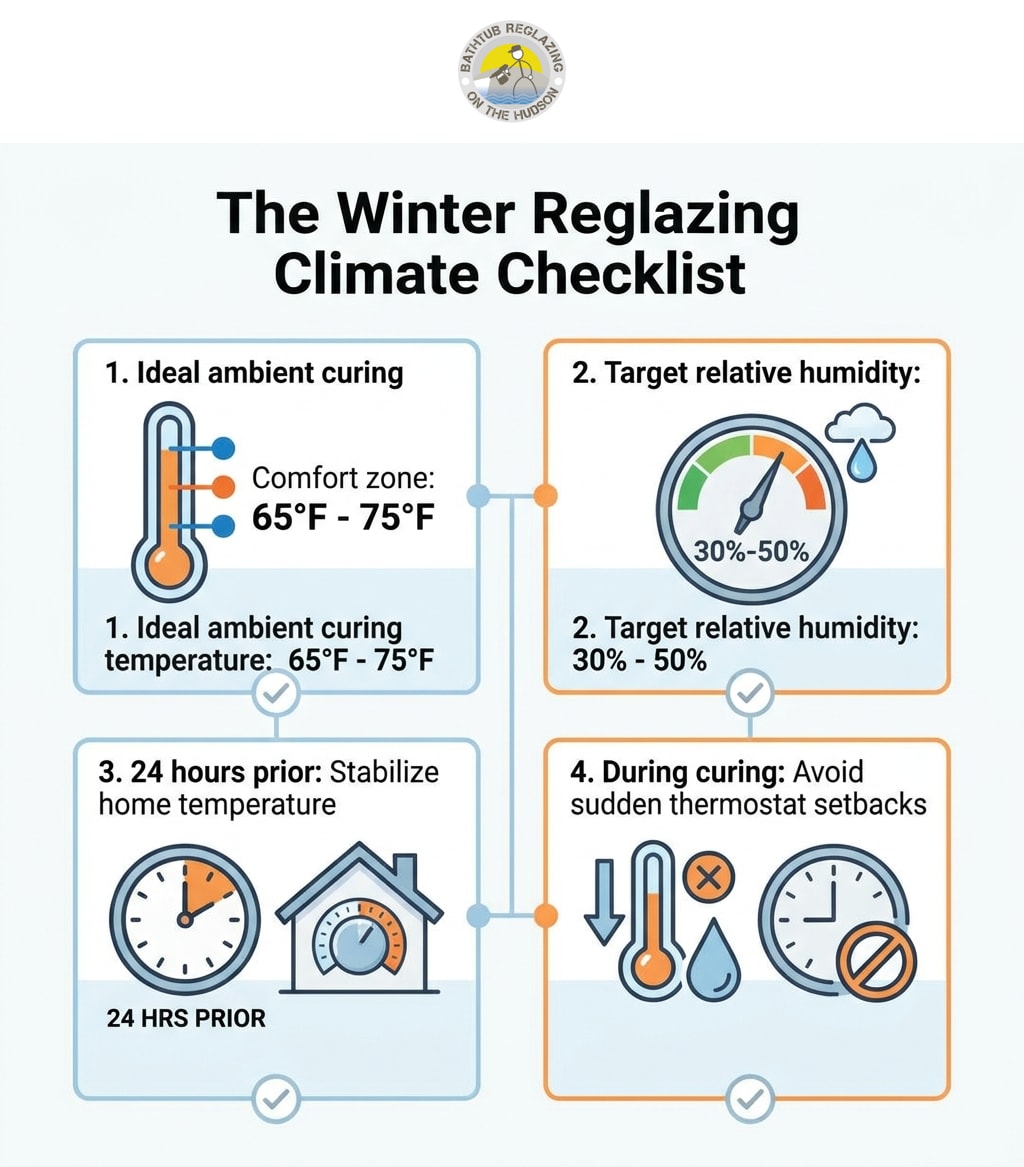
To ensure your home in Peekskill NY is ready for our professional reglazing services, we recommend preparing your HVAC system ahead of time. Taking these proactive steps gives the dense materials in your bathroom enough time to absorb ambient heat.
• 24 Hours Prior: Bring the home to a stable, moderate temperature (around 70°F to 72°F) a full day before the appointment. This allows the thermal mass of the tub to slowly warm up.
• Avoid Drastic Setbacks: Do not use aggressive overnight temperature setbacks the night before the project. Dropping the house down to 60°F while you sleep will undo all the warming progress.
• Open Bathroom Doors: Leave the bathroom doors open to allow your central home heating to circulate and warm the fixtures evenly overnight.
• Trust the Professionals: Do not attempt to set up localized heating or exhaust fans yourself. Our professional team will handle the localized ventilation and micro-climate adjustments upon arrival to ensure the environment is perfectly calibrated.
Post-Renovation: Maintaining the Ideal Environment
The work doesn't stop once our technician leaves. The 24 to 48 hours following the application are just as critical as the preparation phase. During the November pre-winter heating season, your home's climate remains the deciding factor in how well the finish cures.
• The First 24 Hours: Maintain a consistent thermostat setting. Avoid sudden drops or spikes in temperature. If you usually turn the heat off while you are at work, you must leave it on to protect the curing process.
• Managing Ventilation: Keep the bathroom door cracked to allow ambient house air to circulate, but avoid opening bathroom windows. Pulling freezing outdoor air directly onto the curing surface will cause thermal shock and halt the cross-linking process.
• Resuming Normal Schedules: After the initial 48-hour curing window has passed and the surface is fully hardened, you can safely resume your normal smart thermostat setbacks and heating schedules.
Following these timeline steps guarantees the longevity and safety of your newly refinished tub. If you are coordinating a larger project, understanding these timelines is essential for successful bathtub reglazing in Westchester County.
Coordinate Your Winter Renovation with Confidence
At Bathtub Reglazing On The Hudson, we know that a successful winter renovation in Peekskill NY is always a partnership between our professional expertise and your proper home climate management. By understanding how your furnace interacts with the chemical curing process, you can prevent uneven drying, adhesion failures, and thermal shock.
Cold weather shouldn't delay your holiday bathroom updates. With the right preparation and a stable thermostat, you can achieve a flawless, durable result that lasts for years. If you are ready to transform your space before the season gets away from you, schedule your consultation for a professional bathtub reglaze today. We provide the clear instructions and environmental management you need to guarantee a beautiful, lasting finish.
Frequently Asked Questions
What is the best temperature for curing bathtub glaze?
The ideal temperature for curing professional bathtub glaze falls between 65°F and 75°F. Maintaining this specific range ensures that the chemical cross-linking process occurs at the correct speed. If the room drops below this range, the curing process slows down significantly, leaving the tub vulnerable to damage. If it gets too hot, the surface can skin over prematurely, trapping solvents underneath.
How does heating affect indoor humidity during renovations?
Running your furnace constantly during cold weather drastically lowers your indoor relative humidity. Because cold outdoor air holds very little moisture, heating it up inside your home causes it to expand without adding any water vapor. This bone-dry air can pull solvents out of professional coatings too quickly, causing the material to dry unevenly or fail to bond deeply to the fixture.
Should I adjust my thermostat while reglazing in winter?
You should set your thermostat to a stable, moderate temperature (around 70°F) at least 24 hours before the appointment and leave it there. Avoid using aggressive overnight temperature setbacks before or immediately after the project. Consistency is the most important factor; sudden drops or spikes in temperature can disrupt the curing chemistry and compromise the final finish.
Can you remodel a bathroom in the winter?
Yes, you can absolutely remodel a bathroom during the winter months. The key to success is actively managing the indoor micro-climate to compensate for the cold exterior temperatures. Professionals use specialized ventilation and localized heating strategies to ensure materials cure properly, allowing you to complete your updates well before the holiday season is over.
Does cold weather affect paint and enamel curing?
Cold weather heavily impacts the curing process of paints, enamels, and professional urethanes. Low temperatures slow down the evaporation of solvents and halt the chemical bonding required for a hard, durable shell. If applied to a freezing cold surface, the coating may remain tacky for days, develop a dull finish, or eventually peel away from the fixture entirely.
How do you ventilate a bathroom renovation in the winter without freezing the pipes?
Professional technicians use localized exhaust systems that vent fumes directly out a window while sealing off the rest of the opening. This prevents massive drafts of freezing air from entering the room. By drawing warm air from the rest of the house into the bathroom and exhausting it straight outside, the room stays warm enough to protect the plumbing and ensure proper curing.
Schedule Service
Thank you! Your submission has been received!
Oops! Something went wrong while submitting the form.
Other Blogs
Customer Testimonials
Hear what customers are saying about our professional refinishing and outstanding results.

Can’t say enough about Maurice. From start to finish great communication his work is incredible and he stands by it very competitive pricing just all-around good guy the work was done quick and kept very clean and our brand new bathroom
Joey N.
We had a large piece of bathtub glaze chip off. Maurice came in and did a fantastic job. It now looks and works better than before. He went above and beyond the contract by cleaning up the old chipped grout between the tub and the tiles and replacing with brand new.
Bozidar J.
Maurice did a great job on my tub. It looks brand new.
Steven S.