
The Hidden Risk of Late-Season Unit Turns
If you are managing rental properties as the weather cools, understanding Thermal Shock: How Freezing Temperatures Affect Curing Enamel is critical to preventing costly maintenance failures. At Bathtub Reglazing On The Hudson, our team frequently sees the challenges property managers face when turning over apartments in Peekskill and the surrounding areas. You already know that turning over an apartment requires a delicate balancing act of scheduling plumbers, painters, and cleaners. However, surface restoration operates on a completely different set of physical rules. When you schedule a bathtub resurfacing project, you are not just waiting for a layer of paint to dry. You are initiating a complex chemical reaction that is highly sensitive to its environment.
During mid-fall and October, the pressure to complete unit turns before winter sets in becomes intense. Property managers often face a critical decision: schedule surface restorations right now, or push them into the colder months when the heating systems are fully activated. Pushing these tasks back introduces a significant vulnerability. Fresh bathtub coatings require a stable environment to harden properly, and sudden temperature drops can completely ruin the finish.
Successful curing is a precise chemical process. It requires specific ambient conditions to allow the liquid polymers to bond into a solid, durable surface. When you attempt professional bathtub reglazing late in the season without accounting for the rapidly changing weather, you risk interrupting this delicate process. The result is often a failed coating that looks terrible and peels away within weeks, forcing you to start the entire unit turn over again.
Understanding the Science of Thermal Shock in Polymer Coatings
The problem: You schedule a reglazing job on a crisp fall afternoon, but by midnight, the temperature plummets. The cause: This sudden drop triggers thermal shock in the fresh coating. The solution: Maintaining strict ambient temperature controls throughout the entire curing window prevents the chemical reaction from stalling.
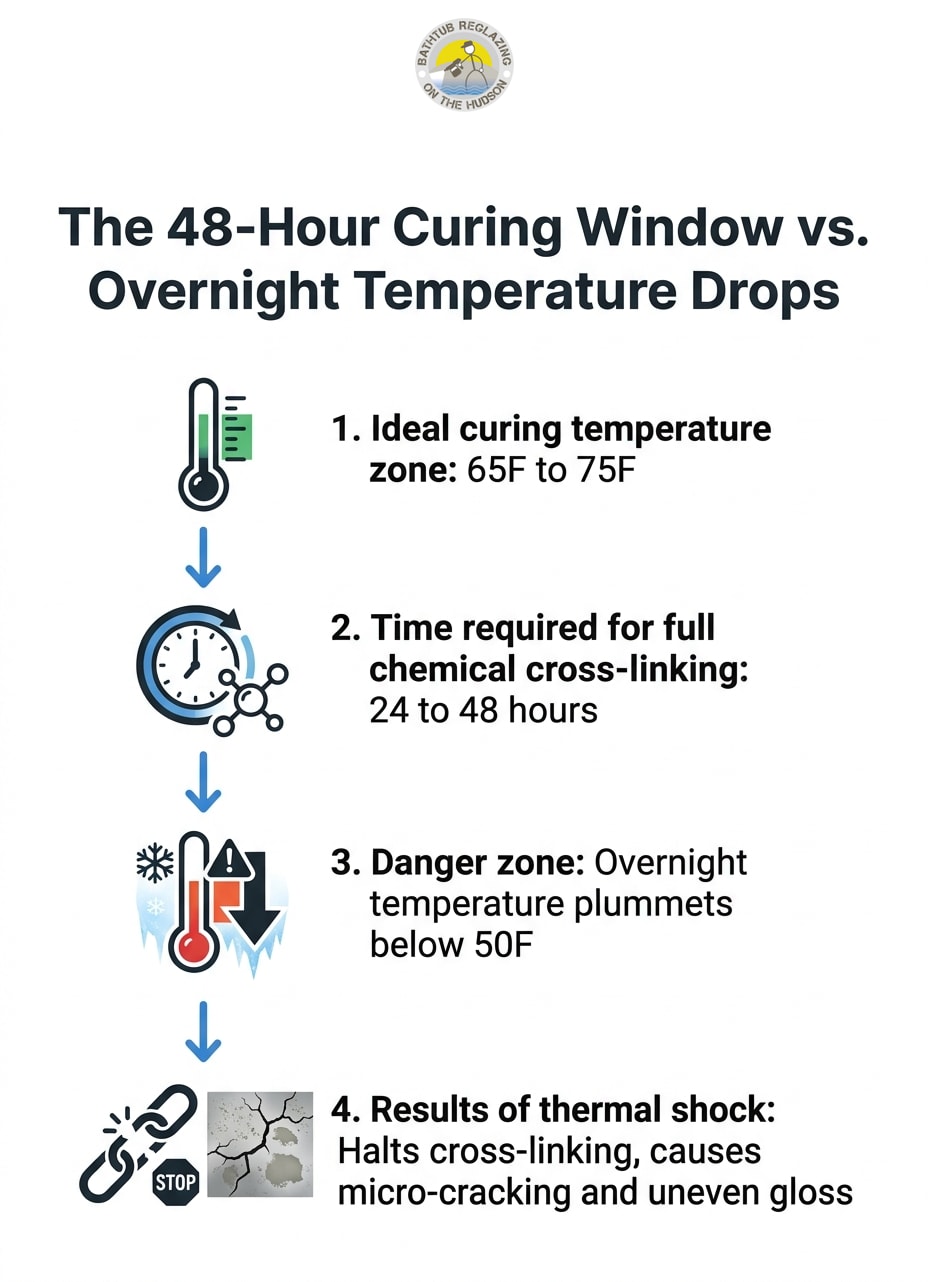
Thermal shock, in the context of architectural coatings and tub enamels, occurs when a rapid decrease in ambient temperature physically shocks the curing polymers. Professional polyurethane and epoxy coatings require a continuous 24 to 48-hour window of stable ambient temperatures—ideally between 65°F and 75°F. This specific heat range acts as the necessary catalyst for optimal chemical cross-linking. When exposed to sub-freezing overnight temperatures, the molecular bonding process simply stops.
It is crucial to differentiate between a coating that feels "dry to the touch" and one that is fully chemically cured. A tub might feel dry on the surface just a few hours after application, but the underlying layers are still actively bonding. If thermal shock interrupts this deeper bonding phase, the structural integrity of the enamel is permanently compromised.
• Wet Application — Physical State: Liquid state, highly volatile — Vulnerability to Cold: Extreme (Immediate failure) — Usability: Do not touch or use
• Dry to the Touch — Physical State: Surface film formed, soft underneath — Vulnerability to Cold: High (Cross-linking stalls) — Usability: Visually set, but easily dented
• Chemically Cured — Physical State: Fully cross-linked polymer matrix — Vulnerability to Cold: None (Fully hardened) — Usability: Ready for daily use and moisture
The Cross-Linking Phase Explained
To understand why cold weather is so destructive to bathroom tile reglazing and tub resurfacing, you have to look at the cross-linking phase. Liquid polymers consist of long, loose chains of molecules. When the curing agent (hardener) is mixed in, these chains begin to link together, forming a tight, impenetrable web. This web is what gives the final enamel its extreme durability, water resistance, and glossy shine.
Ambient heat is the engine that drives this reaction. The warmer the room (within the safe 65°F to 75°F limit), the more active the molecules are, and the tighter they bind. When a sudden cold front hits, the molecules lose their energy. They slow down and eventually stop moving before the web is fully formed. The reaction does not simply pause and resume when the room warms up again; once the cross-linking process is broken by thermal shock, the coating is permanently weakened.
The Ventilation Dilemma: Open Windows vs. Freezing Drafts
One of the most significant challenges of late-season property maintenance is managing airflow. Natural window ventilation is standard practice for safely extracting toxic fumes during the application process. Professional coatings contain strong solvents that must be vented outside to protect the technicians and the overall indoor air quality of the building.
However, an exact physical conflict arises when you open a bathroom window during the late fall months. You are attempting to push warm, fume-heavy air out while inadvertently pulling frigid, dense air directly onto the curing surface. This creates a severe ventilation dilemma. The local climate's sharp overnight temperature drop creates a very narrow, unpredictable window for safe natural ventilation. What works perfectly at 2:00 PM can become a freezing hazard by 6:00 PM.
Cold drafts alter the surface tension of the coating as it sets. When a blast of cold air hits a section of the tub, that specific area cools and contracts faster than the surrounding enamel. This uneven drying tension pulls at the polymer chains, disrupting the smooth finish and leading to visible defects. Understanding how cold drafts cause uneven gloss levels is essential for anyone scheduling property maintenance during this transition period.
Furthermore, relying on closed-system heating complicates safe fume extraction. If you close the windows to keep the tub warm, the fumes become trapped inside the unit. If you open the windows to vent the fumes, you freeze the tub. This paradox is exactly why timing your surface restorations before the deep freeze is so critical.
Micro-Cracking, Bubbling, and Uneven Gloss Levels
When thermal shock interrupts the curing process, the consequences are both visual and structural. A coating that fails to cross-link properly will not stand up to the daily wear and tear of a rental unit. Here is the exact sequence of how a thermally shocked coating breaks down:
1. Loss of Surface Gloss: The first visual sign of an interrupted cure is a dull, cloudy appearance. Instead of a bright, mirror-like shine, the enamel looks flat or hazy in patches where the cold air hit it hardest.
2. Surface Bubbling: As the uneven surface tension pulls at the weak polymer bonds, microscopic pockets of trapped gas or solvent can form bubbles. In one mid-fall scenario our crew encountered, previous contractors failed to account for environmental conditions, causing severe bubbling issues on a tub. Our technicians had to step in to strip the failed coating and properly fix the bubbling issue, ultimately restoring the fixture to a flawless finish.
3. Micro-Cracking: Because the coating is brittle rather than flexible, the natural expansion and contraction of the tub (when hot water hits it) causes microscopic spiderweb cracks across the surface.
4. Moisture Penetration: Once the tub is put into use by a tenant, water from the shower easily penetrates these micro-cracks. The moisture works its way under the weak enamel, breaking whatever fragile bond remains between the new coating and the original porcelain.
5. Total Delamination: Finally, the enamel begins to peel away in large strips or flakes. At this point, the tub is unusable, and the only solution is a complete strip and redo.
The cost implications of a failed coating are substantial. You are not just paying for a second reglazing job; you are paying for the labor-intensive process of stripping the ruined epoxy, delaying your tenant move-in date, and potentially losing rental income.
Environmental Controls: Managing Ambient Temperature and Humidity
When natural ventilation becomes physically impossible due to freezing outdoor temperatures, the only way to successfully complete bathtub restorations is through strict environmental controls. Professional technicians do not just spray a coating and leave; they engineer a temporary micro-climate inside the bathroom to ensure the chemical reaction completes successfully.
This requires a professional understanding of environmental controls, ensuring flawless finishes by strictly managing ambient temperature and humidity during the curing phase. If the air is too cold, the cure stalls. If the cold air brings in high humidity, the moisture can get trapped in the finish, causing blushing (a milky white haze) or poor adhesion.
Isolating the Curing Zone
To maintain the perfect 65°F to 75°F sweet spot continuously for 48 hours, the bathroom workspace must be entirely isolated from the rest of the property. This process involves several critical steps:
• Sealing the perimeter: Technicians use heavy-duty plastic sheeting and specialized tape to seal off the bathroom door, preventing drafts from unheated adjacent rooms or hallways from entering the space.
• Establishing a thermal boundary: Exterior walls and drafty window frames are insulated or blocked to prevent radiant cold from dropping the room's ambient temperature.
• Controlled exhaust systems: Instead of simply opening a window, professionals use high-powered, heated exhaust fans. These systems use flexible ducting to safely pull toxic fumes out of the room while simultaneously maintaining negative pressure, all without sucking freezing outdoor air back into the curing zone.
• Supplemental climate control: Safe, indirect heating elements and dehumidifiers are deployed to keep the ambient air warm and dry, ensuring the polymer chains cross-link perfectly regardless of the weather outside.
Risk Management for Winter Unit Turns
Translating the scientific explanation of thermal shock into a logistical strategy is essential for protecting your property investments. Pushing tub and tile restorations into the deep winter significantly increases operational complexity and risk. In Peekskill NY and the greater Hudson Valley, the region's transition to sub-freezing weather dictates proactive maintenance schedules for landlords.
To avoid the headaches of thermal shock, property managers should implement a strict risk management protocol during the mid-fall season:
• Audit unit conditions early: During mid-fall inspections, identify every bathtub, shower pan, and tile surround that shows signs of wear, chipping, or hard water damage.
• Evaluate rust and structural damage: Cold weather exacerbates existing damage. During a winter unit turn, our team discovered a tub with severe rust damage that threatened complete replacement. We efficiently mitigated the rust and reglazed the tub under strictly controlled conditions, saving the owners from replacing the whole fixture. Catching this in October is much easier.
• Schedule before the heating switch: Plan your surface restorations before the building's heating systems are locked into closed-loop winter modes. Once the boiler is running full time and windows are sealed shut for the season, fume extraction becomes a major logistical hurdle.
• Prioritize long-term durability: Remember that a properly cured coating provides years of durable, glossy performance. Rushing a job in freezing conditions guarantees a short lifespan. If you need bathtub reglazing services in Westchester County, booking them during the safe autumn window is the smartest operational move.
Securing Your Property's Surfaces Before the Freeze
The science is clear: polymer coatings and freezing temperatures do not mix. Thermal shock halts the cross-linking process, ruins the surface tension, and ultimately leads to peeling, bubbling, and total failure of the enamel. For property managers, this means that the timing of your unit turns is just as important as the quality of the materials used.
The team at Bathtub Reglazing On The Hudson strongly recommends evaluating your upcoming unit turnovers today. Completing your reglazing projects while the windows can still safely remain open for natural ventilation will save you time, unnecessary stress, and the headache of failed coatings. Secure your property's surfaces now, ensure a flawless chemical cure, and head into the winter season with confidence.
Frequently Asked Questions
What temperature is too cold to reglaze a bathtub?
Anything below 65°F begins to slow down the chemical curing process, but temperatures dropping below 50°F create a severe risk of thermal shock. At these colder temperatures, the polymer cross-linking halts completely. For the best results, the ambient room temperature should remain steadily between 65°F and 75°F for at least 24 to 48 hours after application.
How long does tub enamel take to cure in cold weather?
In cold weather, tub enamel may never fully chemically cure if thermal shock occurs. While the surface might feel dry to the touch after 24 hours, the underlying polymer chains remain weak and unbonded. If the room cannot be artificially heated and maintained at the proper temperature, the coating will remain vulnerable to peeling and moisture damage indefinitely.
Can thermal shock cause bathtub enamel to peel?
Yes, thermal shock is one of the leading causes of premature peeling and delamination. When the temperature drops rapidly, the coating cures unevenly, creating microscopic cracks and weak points in the finish. Once water from the shower penetrates these weak points, it breaks the bond between the new enamel and the tub, causing large sections to peel away.
How do you ventilate a bathroom for reglazing in winter?
Ventilating a bathroom in winter requires professional environmental controls rather than simply opening a window. Technicians seal the room to isolate it from the rest of the property and use specialized heated exhaust systems with flexible ducting. This setup safely extracts toxic fumes outside while maintaining the warm ambient room temperature required for the enamel to cure.
What is the difference between drying and chemical curing for tub coatings?
Drying simply means the volatile solvents have evaporated, leaving the surface firm to the touch. Chemical curing is a deeper molecular process where the polymers cross-link to form a dense, durable, and waterproof matrix. A tub can be dry in a few hours, but full chemical curing requires 24 to 48 hours of sustained, warm ambient temperatures.
Can a failed reglazing job caused by cold weather be fixed?
Yes, but it cannot be simply painted over. A failed coating that has suffered thermal shock must be completely chemically stripped down to the original porcelain or fiberglass. Once the ruined enamel is removed, the surface must be re-prepped, primed, and reglazed under proper, controlled environmental conditions to ensure a successful cure.
Schedule Service
Thank you! Your submission has been received!
Oops! Something went wrong while submitting the form.
Other Blogs
Customer Testimonials
Hear what customers are saying about our professional refinishing and outstanding results.

Can’t say enough about Maurice. From start to finish great communication his work is incredible and he stands by it very competitive pricing just all-around good guy the work was done quick and kept very clean and our brand new bathroom
Joey N.
We had a large piece of bathtub glaze chip off. Maurice came in and did a fantastic job. It now looks and works better than before. He went above and beyond the contract by cleaning up the old chipped grout between the tub and the tiles and replacing with brand new.
Bozidar J.
Maurice did a great job on my tub. It looks brand new.
Steven S.